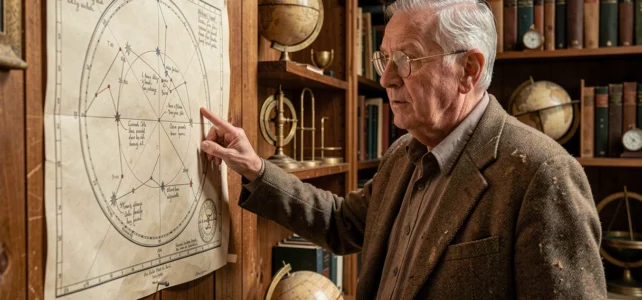
The motif of the seven stars traverses sacred texts, astronomical systems, and esoteric traditions since Antiquity. Far from being a unique symbol with a fixed reading, the 7 stars refer, depending on the context, to an observable stellar group, a theological code, or a geometric figure laden with initiatory meaning. Understanding them requires distinguishing these three registers, often mixed in popular sources.
The Heptagram: Geometry and Reuses of the Seven-Branch Symbol
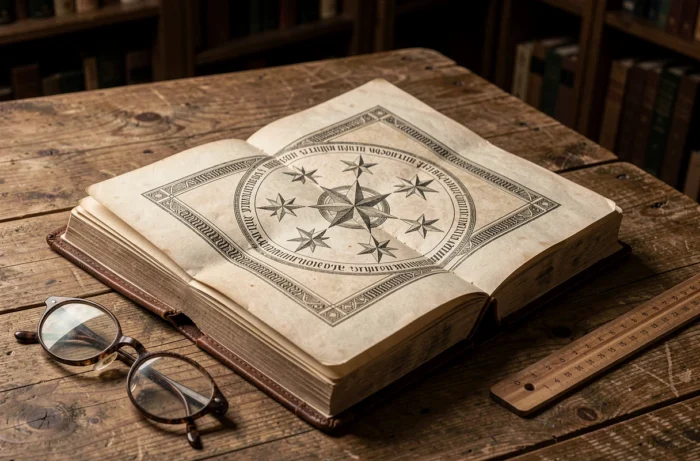
The geometric shape associated with the 7 stars has a specific name: the heptagram. This seven-pointed star polygon is drawn by connecting the vertices of a regular heptagon according to a step of two or three, producing two distinct variants. One features sharp branches, while the other has more open points.
What distinguishes the heptagram from more well-known figures (pentagram with five branches, hexagram with six) is its rarity in European monumental iconography. It can be found in manuscripts of ceremonial magic and in some treatises on astronomy, but rarely engraved on church facades or official coats of arms.
Its modern usage has shifted towards esoteric subcultures. According to an analysis published on Patheos in August 2026, the septagram has been repeatedly re-invested by post-Crowleyan currents, which have re-mythologized it around so-called “septenary” initiatory systems. The current debate focuses less on the original meaning of the symbol than on its successive reappropriations in very different contexts. Aleister Crowley himself did not invent this figure, which largely predated him.
To delve deeper into the meaning of the 7 stars in their multiple traditions, the cross-referencing of historical and religious sources remains the most reliable method.
Seven Stars in the Bible: Revelation, Menorah, and Theology of the Number
The biblical register constitutes the most documented foundation surrounding the 7 stars. In the Book of Revelation, Christ appears holding seven stars in his right hand. The text specifies that these stars represent the angels of the seven Churches of Asia Minor. This passage has generated centuries of theological commentary.

The Menorah, the seven-branched candelabrum described in Exodus, constitutes another major anchor of the number seven in religious tradition. Each branch of the candelabrum has been interpreted as a representation of the days of Creation, the planets visible to the naked eye in Antiquity, or spiritual virtues.
The number seven itself structures the Bible throughout:
- The seven days of Creation in Genesis, which establish the weekly rhythm still in use
- The seven gifts of the Holy Spirit in Christian tradition (wisdom, understanding, counsel, strength, knowledge, piety, fear of God)
- The seven seals, seven trumpets, and seven bowls of Revelation, which punctuate John’s eschatological revelation
The biblical seven functions as a marker of fullness and completion, not as an arbitrary number. The seven stars held by Christ signal total authority over the believing communities, a power that leaves no Church outside its reach.
Visible Seven Stars: The Great Bear and Ancient Astronomy
The third register is astronomical. The seven most famous stars in the northern sky form the Big Dipper, the main asterism of the constellation Ursa Major. These stars (Dubhe, Merak, Phecda, Megrez, Alioth, Mizar, and Alkaid) are visible year-round from the mid-latitudes of the northern hemisphere, as the constellation is circumpolar: it never sets below the horizon.
The Greeks explained this peculiarity through the myth of Callisto, a nymph transformed into a bear by Hera and placed in the sky by Zeus. According to the account reported by Ovid, the sea goddess Thetis, out of loyalty to Hera, refused to welcome the bear into her waters. Hence the observable fact that Ursa Major does not plunge into the sea.
The Romans, a pastoral people, saw in this same configuration a yoke of oxen, hence the Latin name Septem Triones (the seven plowing oxen). This term gave rise to the word “septentrion,” still used in French to denote the north. Ancient astronomy and everyday language thus bear the direct trace of these seven stars.
Seven-Branch Star in Modern Art and Crossed Traditions
The Swedish artist Hilma af Klint produced in 1908 a series titled The Seven-Branch Star, in which her spiritual guides had dictated to her to paint three groups of seven paintings over periods of seven days each. These works, exhibited at the Guggenheim Museum Bilbao, herald certain aspects of modern abstraction while remaining deeply rooted in a codified symbolic system.
This case illustrates a often overlooked point: the septagram in art is not an ornament but a spiritual program. Af Klint did not use the shape for its aesthetic qualities, but as an organizing structure of a meditative practice.
Beyond art, the seven-branch star traverses several traditions:
- In Christianity, it refers to the seven days of Creation and the seven sacraments
- In Jewish Kabbalah, it is associated with the seventh sphere of the Tree of Life (Netzach, victory)
- In certain branches of Islam, it appears on geometric patterns related to the seven Quranic heavens
This convergence between distinct traditions does not prove a common origin. It rather shows that the number seven, through its recurrence in observable natural cycles (lunar phases, days of the week), has served as a universal symbolic matrix.
The 7 stars, whether painted, engraved, or observed in the night sky, condense at each era the spiritual and cosmological concerns of those who gaze upon them. The symbol does not carry a fixed meaning: it reflects the culture that seizes it.