
A move planned in two months, an apartment under renovation, a professional stock overflowing from the garage: in each of these cases, the question of storage units inevitably arises. And with it, the question of the real budget, beyond the price displayed on the homepage of the center. Prices vary according to the size, location, and additional costs that are sometimes discovered after signing.
Indexation of storage unit rents: what the stabilization of the ILC changes
Most self-storage centers index their rates to the commercial rent index (ILC). Between 2022 and 2023, this index saw a marked increase, directly reflected in the monthly payments. Since the end of 2024, the trend has reversed: annual variations in the ILC are close to zero, and even slightly negative in some quarters of 2025-2026.
In practice, this means that the upward pressure on storage unit rents tends to stabilize. For a tenant, this is good news: a contract signed today is unlikely to see its rent rise significantly upon renewal. However, it is advisable to check the indexation clause in the lease, as some operators apply a fixed annual revision, independent of the ILC.
When trying to estimate the cost of renting a storage unit, this indexation data weighs on the budget as soon as one exceeds a few months of rental.
Price of a storage unit based on size and city

The size remains the primary price factor. A unit of a few square meters, sufficient for boxes and small furniture, costs significantly less than a space of ten square meters capable of accommodating the contents of an apartment.
Geographical differences are equally pronounced. Paris displays prices significantly higher than the national average (with an additional cost that can reach half the price observed elsewhere). Lyon, Marseille, or Toulouse fall within an intermediate range, while medium-sized cities and suburban areas offer the lowest prices.
Estimating the right size to avoid overpaying
The common reflex is to take a slightly larger unit “for safety.” Over a rental period of several months, this extra space represents a significant cumulative cost. It is better to list precisely the items to be stored and use the volume calculators offered by most operators.
A well-sized unit costs less than an oversized unit rented for three extra months. If unsure between two sizes, asking the center if a transfer of units during the lease is possible (and free) allows for flexibility.
Additional costs to anticipate before signing a storage lease
The displayed monthly rate does not always cover all expenses. Several items can increase the bill without appearing in the initial price list.
- Insurance: often included in the base rent, but with a limited coverage ceiling. If the value of the stored goods exceeds this ceiling, additional insurance is necessary, charged extra.
- Padlocks and supplies: boxes, protective covers, bubble wrap, and padlocks are rarely provided. Some centers sell them on-site, at a higher price than in supermarkets.
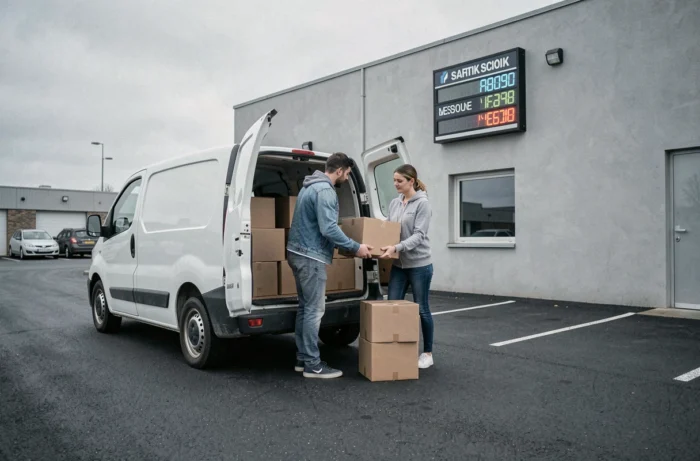
- Transport to the center: this is the item most often forgotten. Renting a van, fuel, tolls, and possibly paid help for heavy loads. For a round trip (drop-off and pick-up), the cost can represent the equivalent of one to two months’ rent for the unit.
Before comparing offers, it is wise to add up all these items to obtain a realistic overall budget, not just an isolated monthly rent.
Parking storage units: the new 2026 regulations
An order dated July 27, 2026, modifies fire protection rules in residential buildings to allow, under strict conditions, the conversion of parking spaces into storage areas. This development potentially opens a new segment of supply, closer to city centers and residential buildings.
However, the constraints are precise:
- Each unit cannot exceed 26 m² in size.
- The doors must be solid, metal, or fire-resistant (minimum E 30 rating).
- Electrical installations are almost prohibited, except for fixed lighting.
- The heat load of the stored goods is limited, with a list of prohibited products.
For tenants, these basement units in buildings could offer more competitive rates than traditional self-storage centers, as the land cost is already amortized. Feedback on this point varies, as the offer remains embryonic and the condominiums that are starting are still rare.
Security and access: what to check
A unit in a building’s parking lot does not necessarily offer the same level of security as a dedicated self-storage center (video surveillance, individualized access control, alarm). Before signing, check if the space is covered by the condominium’s insurance or if a specific guarantee needs to be taken out.
Reducing the budget without compromising the protection of goods
The most effective lever remains the duration. A unit rented “just in case” for six months costs more than a rigorous sorting followed by a two-month rental. Some operators offer the first month free or a decreasing rate beyond a certain number of weeks, which is worth negotiating before committing.
Choosing a center on the outskirts rather than in the city center also helps reduce the bill, sometimes significantly. The compromise is made on travel time, but for storage that is accessed only once or twice, the savings are worth it.
Comparing offers across multiple platforms remains the most reliable method. Price lists vary from one operator to another for nearly identical services, and occasional promotions can sway the choice.
The real budget for a storage unit always exceeds the simple monthly rent. By including insurance, transport, supplies, and the actual rental duration, one obtains an estimate that avoids unpleasant surprises and allows for choosing the offer best suited to real needs.