Which accessories truly change a silhouette, and which ones just clutter a wardrobe? The answer depends less on the trends proclaimed by fashion shows than on a few measurable criteria: versatility, materials, and the price-to-outfit compatibility ratio. The trendy accessories of the moment are characterized by a shift towards pieces that are both minimalist and bold, with a marked increase in online searches for jewelry, watches, and bags compared to 2025.
Trendy Accessories 2026: Comparison of Key Categories
Not all accessory categories are equal in terms of versatility or visual impact. The table below cross-references the main families with three concrete criteria: the average number of outfits a single accessory can accompany, the type of silhouette it modifies, and its compatibility with the major style directions of the season.
| Category | Versatility (compatible outfits) | Silhouette area modified | Dominant trend 2026 |
|---|---|---|---|
| Jewelry (rings, necklaces, earrings) | Very high | Face, neckline, hands | Thick links, architectural designs |
| Bags | High | Bust, hips | Natural materials (raffia, wicker, linen) |
| Belts | Medium to high | Waist, hips | Soft leather, minimalist buckles |
| Scarves and shawls | High | Neck, shoulders, hair | Light cotton, tone-on-tone patterns |
| Hats and caps | Medium | Face, head | Structured bucket hat, streamlined cap |
| Watches | Medium | Wrist | Sleek but bold dials |
The versatility column reveals a clear gap. Jewelry and scarves adapt to nearly an entire wardrobe, while a hat or a watch works within a narrower spectrum of outfits.
Browsing the accessories on the Renée Fashion site, you can see precisely this logic of versatile pieces designed to multiply combinations without multiplying purchases.
Architectural Jewelry and Bags in Natural Materials: Two Dominant Axes
The European fashion trend data for 2026 identifies accessories as the main vector of personal expression, ahead of clothing itself. Two categories concentrate the essence of this dynamic.
Statement Jewelry with Thick Links
The shift is clear: fine and discreet jewelry is giving way to voluminous yet geometric pieces. Architectural rings, wide-link chains, sculpted earrings. The common point is a minimalist design in form but bold in volume.
Steel remains a favored material for this type of jewelry. It resists oxidation, withstands contact with water, and retains its shine without special maintenance. For a piece worn daily, this durability criterion weighs more than seasonal fashion.
Bags in Raffia, Wicker, and Braided Cotton
The crochet or wicker tote is no longer confined to the beach. Structured versions, with interior lining and closure, transition from the Sunday market to the office without visible disruption. Raffia and braided linen provide a texture that synthetic leather cannot replicate, and this tactile dimension immediately distinguishes a silhouette.
However, these natural materials do not handle prolonged moisture well. A wicker bag left in the rain will deform irreversibly. The compromise is to choose lined models with a rigid internal structure.
European Regulation on Unsold Goods: What Changes for Accessories
The European regulation ESPR (Ecodesign for Sustainable Products Regulation, regulation (EU) 2024/1781) has introduced a direct constraint on the accessory market. Since July 19, 2026, large companies can no longer destroy their unsold clothing accessories within the European Union.
In practical terms, a branded bag, belt, or piece of jewelry that does not find a buyer can no longer end up in incineration or landfill. Brands must now direct these stocks towards donation, clearance, or recycling.
The impact for consumers plays out on two fronts:
- Clearance and second-hand circuits will mechanically receive more branded pieces, expanding the offer of trendy accessories at reduced prices.
- Brands are adjusting their production volumes downward to avoid surpluses, which may reduce the availability of certain pieces at the end of the season.
- Accessories designed to last (recyclable materials, timeless designs) gain visibility in collections, as they better meet the requirements of the regulation.
Concrete Criteria for Choosing an Accessory That Lasts More Than One Season
The 2026 trend towards minimalist yet statement designs has a practical advantage: these pieces resist seasonal renewal better than an accessory heavily marked by a micro-trend. A few criteria allow for effective filtering.
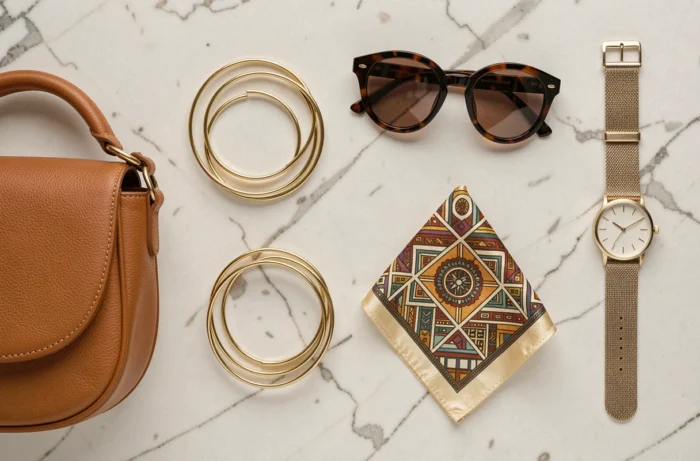
- Color: an accessory in a neutral tone (black, cognac, matte gold, brushed silver) pairs with a significantly higher number of outfits than a colorful piece. Reserve bright color for just one accessory per silhouette.
- Material: steel for jewelry, full-grain leather or lined raffia for bags, woven cotton for scarves. These materials age without visually degrading.
- Proportion: an accessory that is too small disappears, while an accessory that is too bulky creates imbalance. The most reliable proportion rule remains to choose an accessory volume that is the opposite of the garment’s volume: loose outfit, structured and compact jewelry; fitted outfit, more generous bag or scarf.
The transition of accessories to the status of the main vector of personal expression changes the purchasing logic. Rather than accumulating cheap pieces replaced each season, the underlying trend pushes towards fewer, better-chosen references, worn more often. The ESPR regulation reinforces this trajectory by limiting overproduction. A trendy accessory in 2026 is a piece that its owner still wears in 2028.