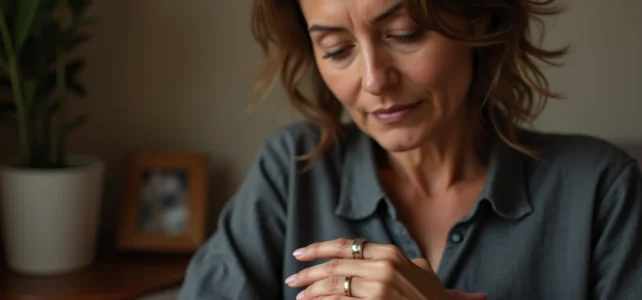
The wedding band of a deceased loved one is not an heirloom like any other. Its alloy, size, and wear tell the story of a life worn on a finger for decades. Before slipping it onto your hand, several technical and symbolic parameters deserve careful attention.
Alloy, wear, and resizing: what the deceased’s wedding band requires before being worn
A wedding band worn for thirty or forty years shows a notable thinning of the inner wall, sometimes an ovalization of the circle. On 18-carat gold models, the loss of material from daily friction reduces the thickness unevenly. A jeweler measures this wear with a gauge before any intervention.
Resizing is the first concrete question. Enlarging a yellow gold ring by two sizes is feasible without weakening the structure. Beyond that, the cumulative thinning (wear + stretching) makes the metal vulnerable to deformation. Reducing a wedding band is technically safer than enlarging it, as excess material is removed rather than stressed.
On rhodium-plated white gold wedding bands, the surface rhodium wears off over time. After resizing, a new rhodium plating restores the shine but subtly alters the appearance that the deceased knew. We recommend discussing this point in advance: some people prefer to keep the original patina as a mark of authenticity.
The choice to wear the wedding band of a deceased loved one also involves checking for the hallmark. Wedding bands made before the 1980s sometimes bear an eagle’s head hallmark (18-carat gold) that can be difficult to read after decades of wear. A touchstone test confirms the gold content without damaging the ring.
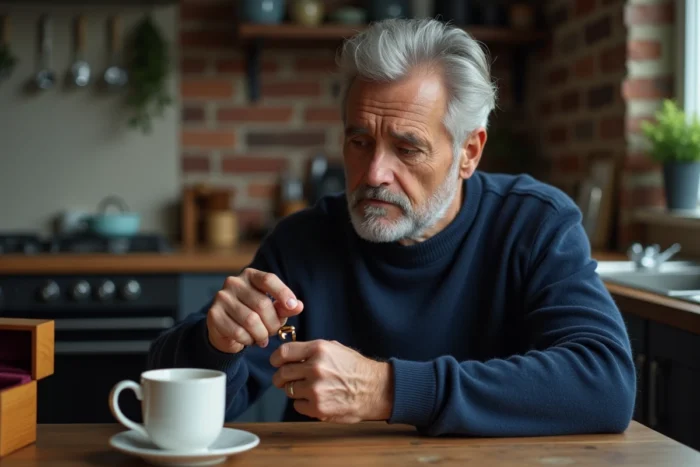
Right ring finger, chain, or layering: the real codification of wearing
The positioning of the wedding band on the right or left hand is not a trivial detail. The left ring finger remains the most recognizable sign of commitment in France, while the right ring finger is perceived as a space for free style, less socially coded. For a widow who wishes to mark a memory link without closing the door to a new relationship, the right ring finger offers this distinction.
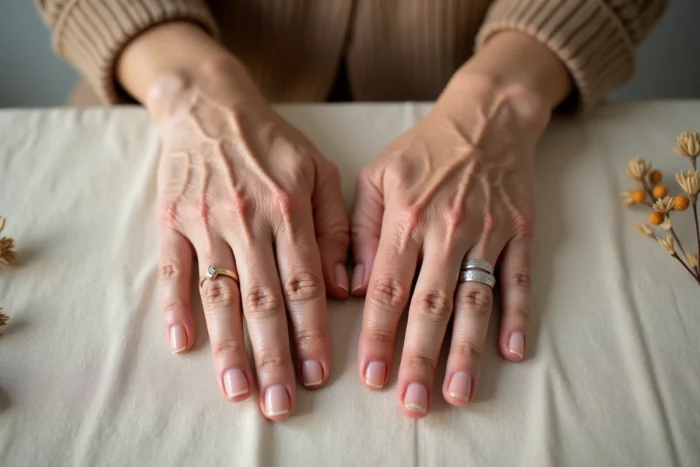
Wearing both wedding bands (one’s own and that of the deceased) on the same finger creates a stacking that can affect comfort. Two rings of different widths and thicknesses can rotate against each other, pinch the skin, or accelerate mutual wear of the metals. If both are gold, the friction remains even. If one is platinum and the other is gold, the platinum (harder) gradually scratches the gold.
Wearing as a pendant: technical constraints
Suspending the wedding band on a chain is a common alternative. The chain must support the weight of the ring without stretching. A forçat link or jaseron link chain in gold of at least 1.5 mm in diameter is suitable for a standard wedding band. Fine 925 silver chains deform under the weight of a solid gold ring within a few months.
The loop (or bail) welded to the wedding band alters the object irreversibly. A non-invasive alternative is to use a tubular ring holder that encases the ring without welding. This detail matters for those who want to preserve the physical integrity of the jewelry.
Deceased’s wedding band as memento mori: an underappreciated use in France
Francophone content almost exclusively addresses the wedding band of the deceased from a marital perspective. Contemporary jewelry creators are repositioning this practice within an older tradition: that of memento mori, the reminder of finitude. The wedding band worn in memory not only symbolizes the bond with the deceased person, it becomes a daily reminder of the value of the present time.
This interpretation changes the significance of the gesture. A child wearing their mother’s wedding band, a friend keeping that of a loved one, does not fall into the marital register. The memento mori broadens the legitimacy of wearing to any significant emotional bond, without a hierarchy of kinship.
Transforming the wedding band into mourning jewelry: concrete trade-offs
Melting down the wedding band to create another piece of jewelry (ring, bracelet, pendant) is a decision that engages the original material. We observe three common scenarios:
- Complete remelting: the gold is melted down and reused in a new design. The original wedding band ceases to exist physically, only the metal remains. This option is suitable when the ring is too worn or too small to be worn.
- Partial integration: the wedding band is set as is in a new support (cage pendant, rigid bracelet with housing). The ring remains identifiable and recoverable.
- Memorial engraving: without altering the shape, a jeweler engraves a date, a word, or a digitized fingerprint of the deceased inside the ring. Laser engraving better preserves thin walls than mechanical engraving.
The choice depends as much on the condition of the wedding band as on the intention of the wearer. A good thickness platinum wedding band lends itself well to direct transmission. A heavily worn 9-carat gold ring is better transformed.
Family transmission of the wedding band: legal and practical questions
The wedding band is part of the estate just like any movable property. In the case of multiple heirs, its allocation may require explicit agreement or be included in a will. In the absence of provisions, it is the surviving spouse who practically retains it, but a child or another heir may claim it.
- Have the wedding band appraised by a jeweler or auctioneer if there are other heirs, to avoid conflicts over value.
- Keep a written record (photo, hallmark certificate, appraisal) if the wedding band is entrusted to a particular family member.
- Plan in one’s own will for the future of this wedding band to prevent it from being lost in a future estate.
The wedding band worn daily wears, patinas, and absorbs the history of the one who wears it. Passing it on to a grandchild in twenty years means entrusting them with an object that will have traversed two lives. This temporal dimension, more than any symbolism, gives the gesture its real weight.