
Creating a landscaped garden at home involves considering data that is rarely compared: soil type, exposure, long-term maintenance budget, and recent regulatory constraints. This article compares the parameters that determine the actual sustainability of a landscaping project, beyond aesthetic choices.
Clay, limestone, or sandy soil: how the substrate changes in a landscaped garden
Most landscaping guides start with style (Japanese, Mediterranean, romantic). The soil, however, decides what grows or not. Before choosing plants, it is essential to identify the dominant texture of the substrate.
| Soil Type | Water Retention | Natural Drainage | Suitable Plants | Main Constraint |
|---|---|---|---|---|
| Clay | High | Low | Hydrangeas, dogwoods, willows | Compaction, winter flooding |
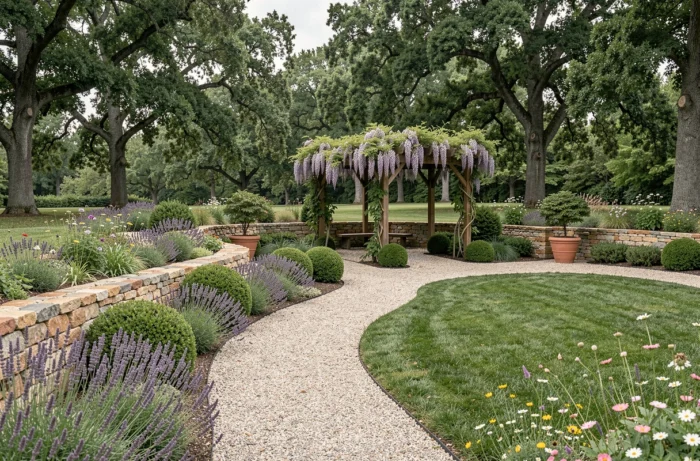
| Limestone | Medium | Medium | Lavenders, boxwoods, rosemaries | Iron chlorosis on acid-loving species |
| Sandy | Low | High | Ornamental grasses, cistus, gorse | Rapid leaching of nutrients |
| Silty | Good | Medium to good | Wide range (roses, perennials, shrubs) | Surface crusting |
A clay soil and a sandy soil cannot support the same shrubs, even under identical exposure. Planting lavenders in poorly drained clay soil leads to losses by the second winter.
A simple water jar test (soil + water, settling for 24 hours) allows for evaluating the clay/silt/sand ratio without laboratory analysis. The professionals listed on jardinsetpayssages.com systematically include this analysis before proposing a planting plan.
Synthetic fertilizers banned by 2027: sustainable fertilization for the garden
As part of the Climate and Resilience Law, synthesized mineral fertilizers will be banned for non-agricultural uses by January 1, 2027. This deadline directly affects individuals, communities, and green spaces outside of sports fields.
For a landscaped garden designed today, this means that any fertilization strategy based on conventional chemical fertilizers must be abandoned in less than two years. It is better to integrate this constraint from the design stage rather than having to revise practices later.
Concrete alternatives to implement from planting
- Domestic compost, made from kitchen and mowing waste, provides a complete amendment that also improves soil structure over the long term
- Organic mulching (shredded branches, dead leaves, straw) limits evaporation, nourishes soil fauna, and reduces weeding needs
- Facilitating plants like legumes fix atmospheric nitrogen and naturally enrich the soil around neighboring shrubs and perennials
- Certified organic fertilizers (ground horn, dried blood, bone meal) remain permitted and offer slow release suitable for hedges and flower beds
Integrating ground covers like white clover between planted areas serves a dual purpose: natural fertilization and weed suppression without resorting to chemical weeding.
Water management in the garden: restrictions and choices of water-saving plants
Summer drought episodes are increasing, and prefectural water restriction orders now affect a large part of French territory during the hot months. Garden watering is the first use restricted during drought alerts.
On the other hand, a landscaped garden designed with drought-adapted species withstands restriction periods without visible damage. The choice of plants at the design stage determines the garden’s resilience to dry summers.
Shrubs and perennials with low water needs
Mediterranean species (cistus, rosemaries, santolines, gauras) tolerate several weeks without water once established. Ornamental grasses like stipas or fescues maintain their form even in dry soil.
A mulch of five to eight centimeters significantly reduces evaporation. Combined with programmed drip irrigation in the early morning, it allows for a reduction in water consumption compared to traditional sprinkler watering.
Grouping plants by water needs zones (hydrozoning) avoids overwatering drought-tolerant species to satisfy the more water-demanding ones. This logic influences the planting plan: hydrangeas and ferns occupy the moist shady areas, while lavenders and thymes fill the sunny spaces.
Burning prohibited and valorization of green waste: a design parameter
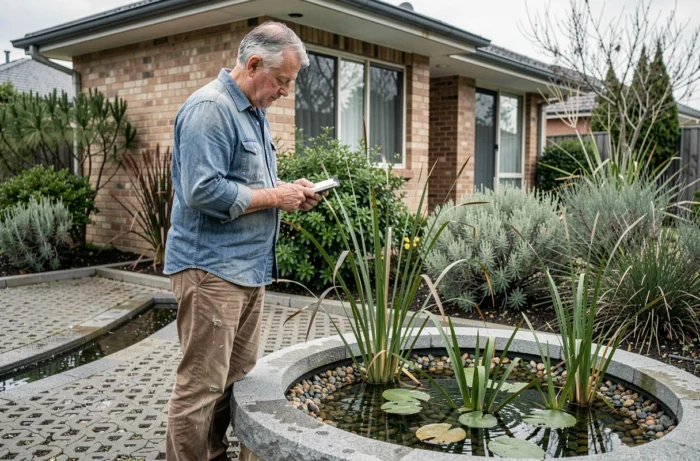
The burning of green waste in the open air is prohibited nationwide, under Article L.541-21-1 of the Environmental Code. This prohibition, reinforced by the AGEC law, requires individuals to valorize their green waste through composting, mulching, or organized collection.
This point has a direct impact on the design of a sustainable landscaped garden. Each hedge, each deciduous tree produces a volume of pruning and leaves to manage each year. Gardens heavily planted with fast-growing shrubs (cherry laurels, privets) generate a considerable volume of green waste.
Planning a composting space from the initial plan, sized according to the planted area, avoids unpleasant surprises. A garden shredder transforms pruning branches into reusable mulch directly at the foot of the flower beds, closing the cycle without removing material from the garden.
Shade, colors, and structure: balancing the zones of a landscaping project
An harmonious garden relies on the distribution of shaded and sunny areas. High-stem trees (maples, oaks, birches) create shaded zones that alter the growing conditions below. Under a dense cover, shade perennials (hostas, heucheras, ferns) replace sunny flower beds.
Structure also comes from mineral elements. The alternation of wood, natural stone, and vegetation avoids visual monotony and creates landmarks in space. A wooden terrace extended by a path of Japanese stepping stones leading to a bed of grasses guides the eye and movement.
Colors should be considered by seasons. A garden that only blooms in May-June appears dull the rest of the year. Distributing blooms from March (forsythias, hellebores) to October (asters, Japanese anemones) with evergreen foliage for winter (boxwoods, osmanthus, nandinas) ensures continuous visual interest.
The sustainability of a landscaped garden is not measured by its beauty on the day of planting, but by its ability to function without chemical fertilizers, with little water, and by valorizing its own waste. The upcoming regulatory constraints make this reasoning not only desirable but mandatory.