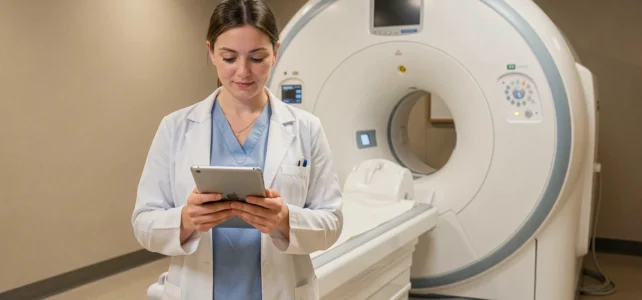
When receiving a prescription for a pelvic MRI at the hospital, the first concern rarely revolves around the examination process. It’s the bill that causes worry. Between the displayed rate, the technical fee, and any potential overruns, the final amount varies depending on the establishment, the radiologist’s agreement, and your health coverage.
Technical fee and medical act: two lines on the same MRI bill
Most online content provides a global price for an MRI without specifying what it covers. In practice, the bill breaks down into two distinct items that can be found on the Health Insurance statement.
The first item is the medical act of the radiologist (reading, interpretation, writing the report). The second is the technical fee, which corresponds to the use of the machine, its maintenance, and consumables. These two amounts add up to form the total cost.
This distinction matters because it determines the reimbursement base. Health Insurance applies its rate to each of these lines separately. An establishment that displays a low conventional rate for the medical act can compensate with a higher technical fee, or vice versa. To effectively compare the price of a pelvic MRI between two facilities, it is therefore advisable to check both components and not just the total.

Sector 1, sector 2, OPTAM: what changes regarding the out-of-pocket cost of a pelvic MRI
The radiologist’s agreement is the factor that weighs most heavily on the final bill. In sector 1, fees are aligned with the Health Insurance rate: no overruns, minimal out-of-pocket cost.
In sector 2, the practitioner freely sets their fees. The overrun can represent a significant part of the total cost. Feedback on this point varies by region and establishment.
In between, there is the OPTAM option (Controlled Pricing Practice Option). A radiologist adhering to this system commits to limiting their overruns. For the patient, this translates into better coverage from Health Insurance and often a broader complementary reimbursement from the mutual insurance.
How to check the agreement before the appointment
The Ameli health directory allows you to check the agreement sector of each practitioner. If the MRI is performed in a public hospital service, the rates are generally conventional. In private clinics or imaging centers affiliated with a hospital, the situation may differ.
Before making an appointment, asking the secretary for the estimated amount with the mention of the technical fee is a simple precaution that avoids surprises.
Social Security and mutual reimbursement: what each level covers
In the coordinated care pathway (prescription from the treating physician or referring specialist), Health Insurance reimburses 70% of the reimbursement base for the pelvic MRI. The remaining 30% constitutes the co-payment, which is usually covered by the mutual insurance.
If you are outside the care pathway (no prescription or direct consultation without referral), the rate drops and the out-of-pocket cost increases significantly. This is a common trap for patients who make an appointment directly at an imaging center without going through their doctor.
What the mutual covers in addition to the co-payment
- The co-payment (the part not reimbursed by Social Security based on the conventional rate) is covered by almost all contracts, even entry-level plans.
- Fee overruns are partially or fully covered depending on the level of the contract. A so-called “100% responsible” contract only covers the co-payment, not the overruns.
- The excess technical fee (when it exceeds the Social Security base) is treated as an overrun by most mutuals, meaning it is only reimbursed if your contract provides for coverage of overruns.
Checking the mention “fee overruns” in your mutual contract before the examination allows you to know precisely what will remain your responsibility.

Prescription, ALD, and special cases of coverage
A pelvic MRI requires a prescription. Without a prescription, no radiologist will perform the examination, and no reimbursement is possible. The prescription must specify the area to be explored and the clinical reason.
For patients with long-term conditions (ALD), coverage can reach 100% of the reimbursement base, eliminating the co-payment. However, fee overruns remain the responsibility of the patient or their mutual, even in ALD.
Situations that modify the out-of-pocket cost
- Beneficiaries of CMU-C or CSS (complementary health solidarity): no out-of-pocket cost for acts in sector 1, as overruns are generally prohibited for these insured individuals.
- Work accident or occupational disease: full coverage by Social Security, including the technical fee.
- MRI with contrast agent injection: a supplement may apply for the injected product, reimbursed on the same basis as the main act but sometimes generating a slight additional cost.
The final amount of a pelvic MRI at the hospital therefore depends less on the type of examination than on the administrative framework in which it is situated. The same act, performed on the same machine, can cost the patient anywhere from almost nothing to several dozen euros depending on the agreement, the care pathway, and the level of mutual insurance. Keeping the prescription, checking the practitioner’s sector, and reviewing the guarantees of one’s health contract are the three actions that effectively reduce the bill.