
We just plugged in a Valberg washing machine, we turn the selector, and there, facing the control panel, we look for the famous spin icon. On the recent models sold by Electro Dépôt, this symbol doesn’t stand out like on other brands. The spin speed is sometimes adjustable only via the digital display, without a dedicated button, which confuses many users.
Spiral, drum, arrow: distinguishing Valberg water-related icons
The first reflex when looking for the spin symbol on a Valberg washing machine is to spot a spiral. In the technical manuals for models like the WF 814 S566C or the WD 8614 A-10D W566C, the “spiral” symbol corresponds to a spin + drain cycle. It is the icon that initiates the rapid rotation of the drum to extract water from the laundry, followed by drainage.
Another icon can be confusing: the drum with an arrow pointing downwards. This one triggers a drain without spinning, meaning the machine drains stagnant water without spinning the drum at high speed. The distinction between these two symbols is rarely explained in consumer guides, and yet it is the source of most programming errors.
To understand the spin symbol on Valberg washing machines, we remember a simple rule: spiral = active spin, drum with arrow = drain only.
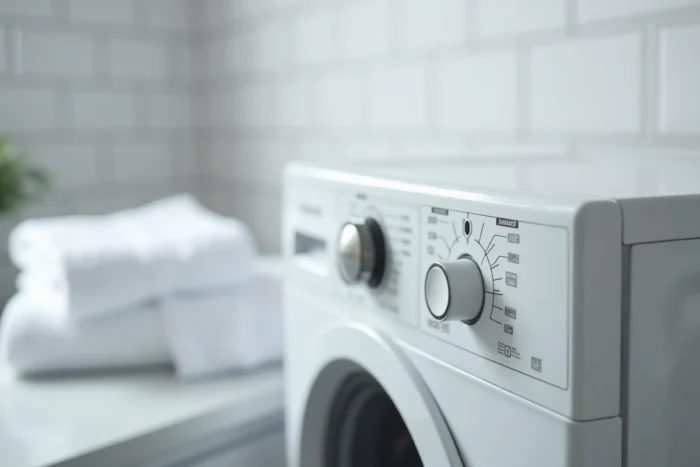
Valberg spin speed: adjustment on digital display
On the latest Valberg models (for example, the WF 814 A-10 W180C), the spin speed is no longer linked to a separate physical button. It is adjusted directly on the digital screen of the control panel by pressing a selection button that scrolls through the available levels: 400, 800, 1000, or 1400 rpm depending on the model.
This operation explains the recurring question on help forums: “where is the spin button on my Valberg?”. There is no button with the spiral icon on these series. The adjustment of the spin speed is done through the digital display, and the selected program sometimes imposes a maximum speed that the user can lower but not exceed.
Adjusting the speed to the type of laundry
A full-power spin is not always desirable. The lower levels (400 or 800 rpm) are better suited for delicate fabrics, fine synthetics, and clothes that are prone to wrinkling. The higher levels (1000 to 1400 rpm) are reserved for cotton, sheets, and towels, which can withstand mechanical stress.
- 400 rpm: wool, lingerie, fragile textiles. The laundry comes out wetter but preserves the fibers.
- 800 rpm: synthetics, shirts, everyday clothing. A good compromise between drying and wrinkling.
- 1000 to 1400 rpm: thick cotton, towels, sheets. Maximum water extraction, reduced drying time.
Valberg “rinse without spin” option: a trap to know
Some Valberg machines offer a rinse without spin option. In practice, the laundry soaks in rinse water without a fast rotation phase. This is useful for very fragile textiles or when you want to postpone the spin cycle.
However, user feedback on appliance help groups indicates that disabling the spin can trigger error codes on some recent series. The machine sometimes interprets the absence of spinning as a cycle anomaly. If a code appears after selecting this option, it is usually enough to restart a spin-only program (the famous spiral icon) for the machine to complete its cycle correctly.
Feedback on this point varies according to series and firmware versions. Consulting the manual specific to one’s model remains the most reliable approach.
Noise and vibrations during spinning: what speed changes in an apartment
Beyond the simple icon, the choice of spin speed has a direct impact on acoustic comfort. The product sheets for Valberg washing machines mention a noise index during the spin phase, and models advertised as quiet display less than 79 dB at full speed.
Reducing the spin speed decreases noise and vibrations, a factor not to be overlooked in an apartment, especially for cycles run in the evening. Moving from 1400 to 800 rpm radically changes the noise level perceived by neighbors. The compromise comes at the cost of longer drying times, but for a nighttime cycle, it’s often the right trade-off.
Stabilizing the machine to limit vibrations
A noisy spin is not always related to the selected speed. If the machine is not perfectly level, the drum amplifies vibrations with each increase in speed. Before systematically lowering the spin speed, check two things:
- The adjustable feet are in contact with the ground, without play. A level placed on top of the washing machine can help ensure this.
- The transport bolts have been removed during installation. These are the screws at the back of the machine that lock the drum during transport. Forgetting them causes abnormal vibrations and can damage the appliance.
- The laundry is evenly distributed in the drum. An unbalanced load (a sheet rolled into a ball, for example) triggers an imbalance that the machine compensates for by automatically reducing the speed or even stopping.
The spin symbol on a Valberg machine is summarized by two icons (spiral for spinning, drum with arrow for draining) and a digital speed adjustment. Identifying these elements on the control panel takes a few seconds once you know what to look for. The rest is a matter of adapting to the type of laundry and the constraints of your living space.