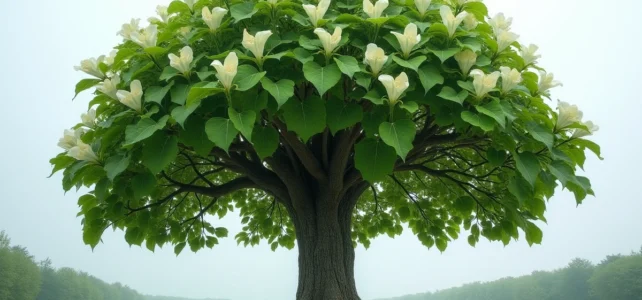
The word “catalpa” does not come from Latin or Greek. It originates from an Indigenous American language, that of the Muscogees (also known as Creeks), a Native American people from the southeastern United States. The English naturalist Mark Catesby first recorded the term between 1731 and 1748 in his work dedicated to the flora of Florida and Carolina. The tree then traveled to Europe, where it found a place in ornamental gardens as early as the 18th century.
Catalpa and Indigenous Etymology: What the Name Reveals About the Tree
The term catalpa derives from the Creek word “kutuhlpa,” which referred to the characteristic shape of the tree’s head. Some sources associate this word with the idea of “winged head,” in reference to the large heart-shaped leaves that crown the canopy. This etymology passed into English and then into French without notable alteration.
What distinguishes this linguistic history is that it reflects Indigenous botanical knowledge predating European classification. The Cherokee, another southeastern American people, also knew this tree and used it. The catalpa was named by those who lived under its shade, long before European botanists cataloged it. To delve deeper into the origin and meaning of the catalpa, several historical and symbolic dimensions deserve exploration beyond the simple botanical facts.
The word was incorporated into French in 1771, according to the Catholicon, and has never been further Frenchified. It remains one of the few common tree names in France directly derived from an Indigenous American language, alongside sequoia or pecan.
Catalpa bignonioides and Catalpa speciosa: Two Species, Two Trajectories
People often refer to “the” catalpa as if it were a single tree. In reality, two species circulate in European gardens and parks, each with distinct characteristics.
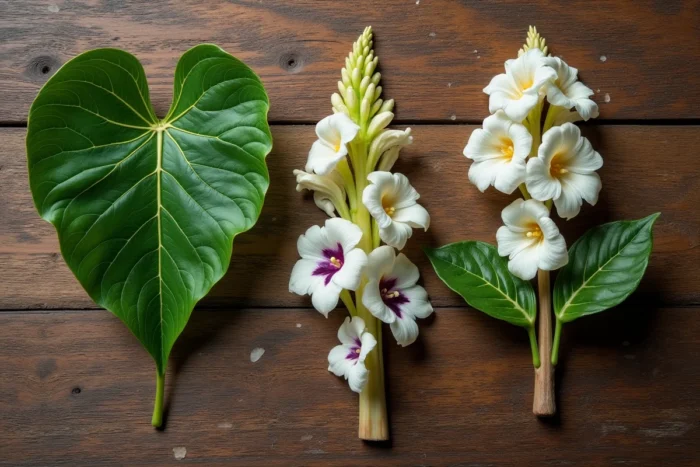
The Catalpa bignonioides, known as the common catalpa or “bean tree,” is the most widespread species in France. Native to the southeastern United States, it rarely exceeds fifteen meters and is recognized by its clusters of white flowers speckled with purple, followed by long hanging pods that persist through winter.
The Catalpa speciosa, sometimes called the cordate-leaved catalpa, grows naturally further north (Mississippi Valley). Its form is more upright, its leaves larger, and its flowering slightly earlier. North American nurserymen recommend it for large spaces, as it reaches larger dimensions than its southern cousin.
Both species share deciduous foliage and panicle flowers. However, their cold resistance and growth rates differ. The speciosa tolerates harsh winters better, which explains its presence in more northern regions of the American continent.
Symbolism of the Catalpa: Serenity, Protection, and Memory
In the language of flowers and the symbolism of trees, the catalpa occupies a unique place. Several traditions attribute converging meanings to it.
- Serenity: Its spreading form, generous shade, and the softness of its white flowering make it a symbol of calm and contemplation. In Quebec, a catalpa referred to as “blessed” grows in the garden of the Augustinian monastery, associated with the spiritual memory of the place.
- Protection: Its broad leaves, among the most imposing of all deciduous trees cultivated in temperate climates, evoke a natural shelter. This image of refuge is found in parks and gardens where it is planted to shade resting areas.
- Memory and Tribute: The catalpa is sometimes chosen for commemorations or planted in memory of an event. Its longevity and recognizable silhouette make it a landmark tree in the landscape.
These symbolic dimensions do not stem from a single tradition. They have built up through accumulation, between Indigenous uses, monastic gardens, and European public parks.
The Catalpa in Ceremonies
Some sources mention the choice of the catalpa for outdoor wedding ceremonies, due to its dense shade and the aesthetic of its summer flowering. This practice remains anecdotal in France, but it illustrates the emotional weight that this tree can carry.
Catalpa in the City: A Tree Adapted to Urban Heat Waves
Beyond its history and symbolism, the catalpa is receiving renewed interest in a very concrete context: the adaptation of cities to recurring heat waves. Since the early 2020s, landscapers and municipalities have cited it among the species to prioritize for cooling urban spaces.
Its dense foliage creates thick shade, and its relatively rapid growth allows for a green cover in just a few years. Urban planning professionals emphasize the principle of “the right tree in the right place” and place the catalpa in the category of trees capable of producing generous shade in contexts of urban overheating.
This utilitarian aspect does not contradict its ornamental dimension. The catalpa combines both functions, which explains its presence in greening projects as well as in private gardens. Its flowers attract pollinators, and its long pods, sometimes considered cumbersome in autumn, actually constitute an often-underestimated element of biodiversity.
Catalpa Diseases and Limitations to Know
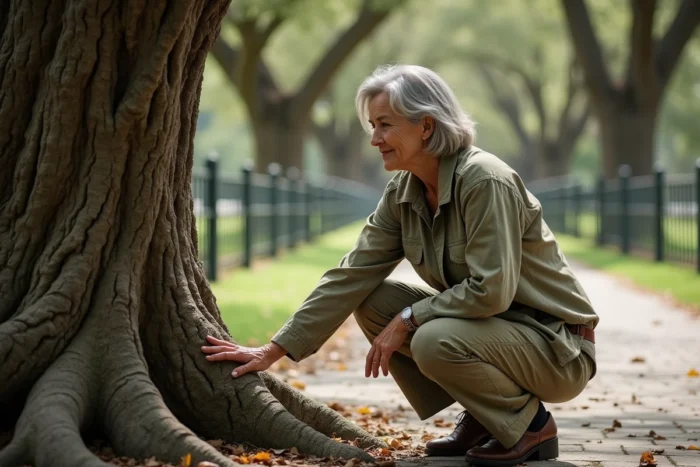
The catalpa is not without its vulnerabilities. Among the most common problems are fungal attacks on the foliage, notably powdery mildew and verticillium wilt, which can cause premature browning of the leaves.
The caterpillars of the catalpa sphinx (Ceratomia catalpae) represent another factor to watch for, especially in North America. In France, this caterpillar is not common, but other pests can affect the foliage.
The catalpa does not tolerate compact and poorly drained soils well. A location that is too confined or soil that is constantly waterlogged compromises its vigor. Brittle branches also constitute a point of vigilance in areas exposed to strong winds. These limitations do not negate the qualities of the tree, but they require careful consideration of its placement before planting.
A tree named by the Muscogees, described by Catesby, planted in the gardens of Versailles and then in the overheated streets of the 21st century, the catalpa has traversed the ages, changing roles without losing its silhouette. Its place in the French landscape is due as much to the beauty of its flowering as to its ability to meet very current needs for greening and shading.