Ecological construction in France is no longer just about choosing natural insulation or installing solar panels. Since January 2025, the RE2020 has lowered the carbon threshold for materials used in new single-family homes to 530 kg CO₂ eq./m², down from around 640 kg during the previous period. This regulatory tightening redefines technical choices right from the project’s sketch stage.
What materials and construction systems can truly meet these thresholds? The available data on recent building permits shows significant discrepancies between sectors.
RE2020 Carbon Thresholds: What the Numbers Impose on Builders
The carbon trajectory of the RE2020 operates in stages. The transition to the 2025-2027 threshold represents a reduction of nearly 17% compared to the 2022-2024 period. The next milestone, scheduled for 2028, will further lower the limit, rendering some current construction solutions incompatible with the regulations.
| Period | Construction Ic Threshold (single-family home) | Sector Consequence |
|---|---|---|
| 2022-2024 | ~640 kg CO₂ eq./m² | Traditional concrete still acceptable with optimizations |
| 2025-2027 | 530 kg CO₂ eq./m² | Reduction of concrete, increased use of wood and bio-sourced materials |
| 2028+ | Even lower threshold (published trajectory) | Only a minority of current constructions would already be compliant |
An analysis covering nearly 108,000 RE2020 buildings shows that only a minority of new homes would meet the future 2028 thresholds today. Builders who do not anticipate this trajectory will have to abruptly adapt their methods in less than two years.
Industries offering resources and feedback on these constraints are multiplying. Notably, platforms like france-eco-construction.fr bring together stakeholders in sustainable construction in France.
Wood Construction vs. Low Carbon Concrete: Performance Comparison
Structural wood (frame, CLT, post-beam) has a significantly lower carbon footprint than traditional concrete. The RE2020 also values the biogenic carbon stored in wood, creating a direct accounting advantage on the construction Ic indicator.
Low carbon concrete is progressing thanks to the partial substitution of Portland cement with alternative binders. However, even optimized, its footprint remains significantly higher than that of a wood structure for a single-family home.
- Wood structure (frame or CLT): among the lowest material carbon impacts, biogenic carbon storage accounted for, reduced construction times due to prefabrication
- Low carbon concrete (CEM III or geopolymers): footprint reduction of 20 to 40% compared to standard concrete depending on formulations, but still above wood on the Ic indicator
- Mixed wood-concrete solutions: concrete slab on the ground combined with a wooden superstructure, a common compromise that optimizes the overall balance while maintaining thermal inertia on the ground floor
The timber and wood construction market is experiencing growth driven by this regulatory constraint. Wood appeals to an increasing share of future homeowners not as a trend, but because it is currently the material that most easily secures RE2020 compliance.
Bio-sourced Materials for Insulation: Straw, Hemp, Cellulose Wool
Insulation is a crucial factor in calculating the construction Ic. Bio-sourced insulators combine two advantages: a low carbon impact during manufacturing and biogenic CO₂ storage.
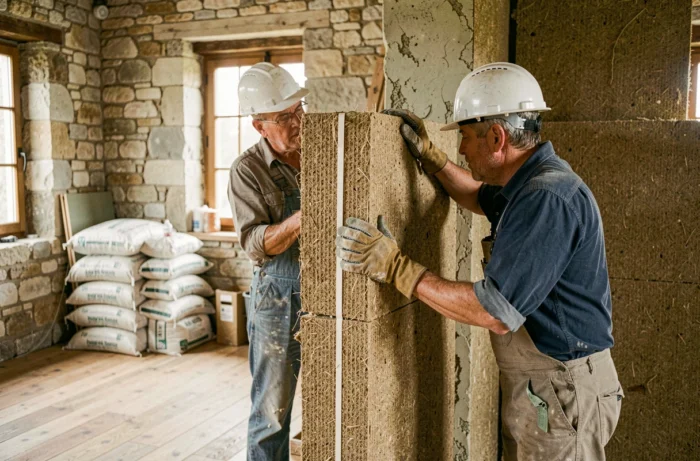
Straw, used as infill in wooden frames, has one of the most favorable balances. Hemp in bales or hemp concrete offers good hygrothermal regulation. Cellulose wool, made from recycled paper, remains the most widely used bio-sourced insulator in France due to its performance-price ratio.
A well-installed bio-sourced insulator achieves the same thermal performance as a petrochemical insulator, with a carbon balance reduced by half or more. The difference lies in the implementation: sometimes thicker layers, sensitivity to moisture requiring an appropriate vapor barrier, and variable availability depending on the regions.
Beware of Certifications and Traceability
A bio-sourced material without an FDES (Environmental and Health Declaration Sheet) cannot be valued in the RE2020 calculation. Project owners must ensure that each product has verifiable environmental data, or they risk being subject to penalizing default values.
Energy and Envelope: The Trade-offs Impacting the Overall Balance
The RE2020 is not limited to the carbon of materials. The Bbio indicator (bioclimatic need) imposes a high-performance envelope even before discussing equipment. Orientation of windows, building compactness, solar protections: these architectural choices reduce heating and cooling needs without adding technology.
On the energy side, the air-water heat pump dominates new single-family homes compliant with the RE2020. Gas heating has been excluded from new constructions since 2022. Thermal or photovoltaic solar systems complement the setup but do not compensate for a poorly designed envelope.
In contrast, massive reliance on technical equipment without working on the envelope leads to significant additional costs and increased maintenance dependence. A high-performance envelope remains the primary lever for energy sobriety, well before the choice of production system.
The upcoming 2028 thresholds will make these trade-offs even tighter. Projects submitted now with a wooden structure, bio-sourced insulation, and careful bioclimatic design are positioned with a comfortable margin. Those who postpone these choices risk having to revise their plans just months before the permit submission, with the associated cost overruns.