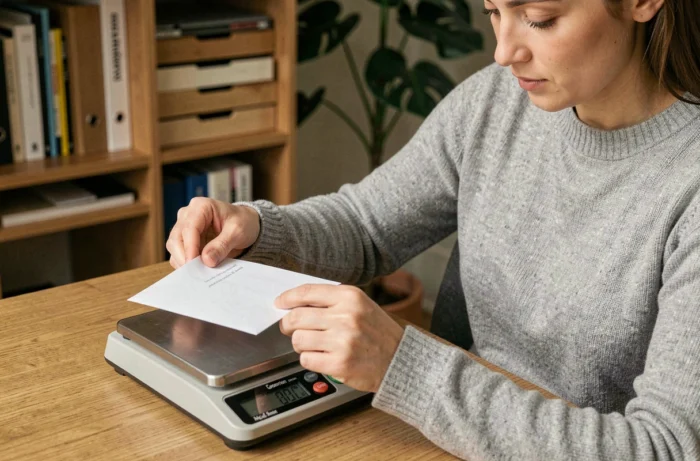
Estimating a letter’s weight before adding postage involves more than counting the sheets inside the envelope. The mailpiece’s format, its thickness once sealed, and the type of paper used all affect the applicable postage rate. Several online tools can estimate the weight without a physical scale, but the mailing category also depends on dimensions that these calculators cannot measure for you.
Letter postage bands: weight, dimensions and thickness at a glance
Competitors explain how many stamps to use, but rarely cover how weight and format combine to determine the actual rate. The table below summarizes the thresholds to keep in mind for a green or priority letter sent within mainland France.
| Weight band | Maximum dimensions (L x W) | Maximum thickness | Category |
|---|---|---|---|
| Up to 20 g | 23.5 x 12 cm | 0.5 cm | Standard letter |
| Up to 100 g | 23.5 x 12 cm | 0.5 cm | Standard letter |
| Up to 250 g | 35.3 x 25 cm | 3 cm | Large-format letter |
| Up to 3 kg | Depending on parcel/letter service | 3 cm | Letter or small item |
The key figure to watch is the maximum thickness of 3 cm. A mailpiece weighing just over 20 g but exceeding 0.5 cm in thickness is automatically classified as large format, which costs more. Weight alone does not tell the whole story.
To weigh a letter online and find out how much postage it needs, simply enter the number of sheets, the envelope size, and any additional items (card, photo, cardboard document). The calculator estimates the total weight and suggests the corresponding rate.

Estimated weight near a postage threshold: how to avoid a surcharge
The most common case is a letter whose estimated weight is very close to a threshold, for example around 20 g or 100 g. Adding just one sheet can move it into a higher postage band.
Why online tools sometimes underestimate the actual weight
Calculators use a standard weight for office paper. In practice, several factors can add a few grams that are easy to overlook:
- The paper’s actual weight varies by brand and finish (matte, glossy, recycled). Premium paper weighs noticeably more than standard printer paper.
- The envelope itself is not weightless, especially window envelopes or padded ones.
- A paper clip, sticky note, adhesive label, or self-sealing flap can each add a few grams, which soon add up.
When the calculated weight is close to a threshold, the calculator’s margin of error may be enough to push it over the limit. Paying for the next postage band costs a few cents more, but avoids having the letter returned for insufficient postage.
Check the mailpiece once sealed
Online postage services offer preset formats, but the sender is still responsible for the dimensions declared. Selecting “standard letter” on a form does not remove the need to measure the envelope once it has been filled and sealed.
A simple tip: place the mailpiece on a flat surface and check that it is no more than 0.5 cm thick to qualify as standard format. If it is thicker, the applicable rate changes even if it weighs less than 20 g.
Mailpiece thickness and format: what weight alone cannot tell you
La Poste sets minimum dimensions of 14 x 9 cm and maximum limits that include a thickness of 3 cm for large-format letters. A small rigid item (USB drive, badge, plastic card) can make an envelope exceed the standard thickness limit without pushing its weight above 20 g.
This mismatch between weight and volume creates a gray area. An online calculator gives a rate based on the declared weight, while automated sorting equipment at the postal center detects excess thickness. An overly thick mailpiece is reclassified as large format or rejected by the automated sorting system.
Small items at letter rates: the 3 cm rule
La Poste states that some small items can qualify for letter rates if the total thickness, including packaging, is less than 3 cm. This option is useful for sending thick documents, photos mounted on cardboard, or small flat accessories.
The requirement is strict: the mailpiece must pass through the standardized slot. If the envelope bulges or resists bending, it will be treated as an item rather than a letter, regardless of the weight shown by the calculator.
Online postage or at the counter: what digital services change (and what they don’t)
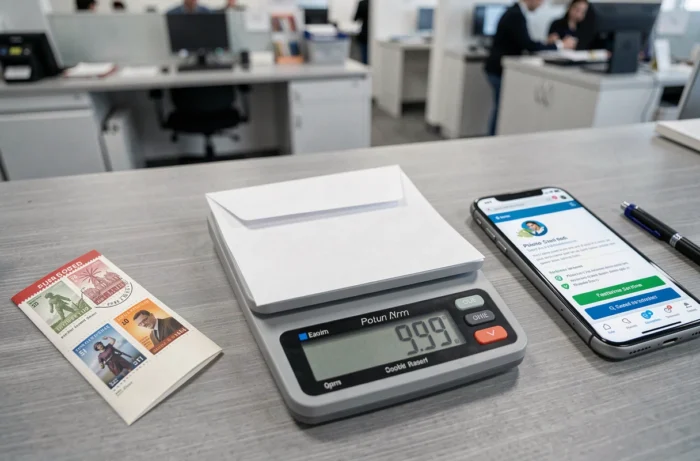
Printing a stamp at home saves you a trip, not a check. Online services do not replace physically measuring the mailpiece. The tool calculates a theoretical weight based on the information you provide. If the actual contents differ (heavier paper, a last-minute addition, a padded envelope), the printed postage may be insufficient.
At the counter, a postal clerk weighs the mail on a calibrated scale and checks its format. The risk of error is virtually zero. When you use an online service, the responsibility rests entirely with the sender.
For regular or business mailings, a postal scale at home is the most reliable companion to an online calculator. Models accurate to the gram are inexpensive and remove any uncertainty for mailpieces close to a weight threshold.
One final point to keep in mind: postal rates are revised every year. An up-to-date online tool includes the current rates, but a bookmark saved several months ago may show outdated prices. Checking when the calculator was last updated before confirming postage helps avoid unpleasant surprises during sorting.