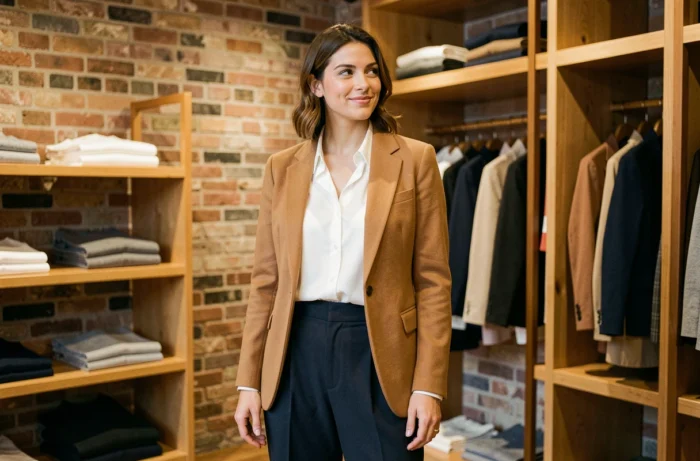
The French textile market is entering a phase where regulation directly impacts stylistic choices. Since September 1, 2026, the anti-fast fashion law imposes an environmental surcharge on ultra fast fashion items, with an additional cost that can exceed €10 per item depending on the category, capped at 50% of the pre-tax price.
This eco-contribution mechanism, managed via Refashion, reshuffles the cards of the chic wardrobe: cheap, fast-turnover pieces lose their price advantage, and wardrobes built around sustainable basics become the most rational option.
Textile eco-contribution and clothing arbitration: what changes for a chic look
The environmental surcharge does not hit uniformly. Brands classified as ultra fast fashion pay eco-contributions that vary based on the number of new references launched and the low encouragement for repairs. An €8 jean imported from a weekly turnover platform now bears a significantly heavier surcharge than a €70 raw jean from a brand that limits its collections.
We are already observing a shift towards “less but better” ranges among several players in the French market. The offer of ultra cheap faux chic, which relied on constant renewal, is mechanically contracting. For the consumer seeking a polished style, this is a clear signal: investing in repairable and timeless pieces is no longer just an aesthetic choice; it’s an economic calculation.
This logic aligns with Style and Chic’s fashion advice, which directs towards pieces with high longevity rather than impulsive low-cost purchases.

Noble materials and weight: the technical criteria for a sustainable wardrobe
A chic blazer is not distinguished by its cut alone. The density of the fabric determines the garment’s durability over time. A wool fabric with a sufficiently dense weight retains its structure after dozens of dry cleanings, whereas a lightweight polyester deforms within weeks.
We recommend systematically checking the composition on the label before purchase. The materials to prioritize for a chic wardrobe that ages well include:
- Merino wool or cashmere for knits: natural thermoregulation, superior resistance to pilling compared to synthetic fibers when the weave is tight
- Poplin or twill cotton for shirts and pants: twill offers better abrasion resistance than poplin, a point often overlooked
- China silk or duchess satin for dressy pieces: crepe withstands repeated washings better than satin, which shows marks at the slightest friction
- Full-grain leather for accessories: a full-grain leather bag develops a patina, while a synthetic one cracks
The choice of material also affects reparability. A seam on wool can be easily repaired. On a thermobonded synthetic fabric, repairs are often impossible, which increases the manufacturer’s eco-contribution and, ultimately, the final price.
Colors and dyes: an underestimated angle
Subtle colors (black, navy, cream, camel) are not just an aesthetic choice for a chic look. Dark solid dyes better mask wear and require fewer washing cycles, extending the garment’s lifespan. Trendy prints with high saturation, on the other hand, go out of style in a season and do not withstand repeated stain removals well.
Building a chic look with five key pieces rather than twenty basics
The classic capsule wardrobe approach lists around twenty interchangeable pieces. We find this counterproductive. Too many average basics create a bland wardrobe. The most effective strategy relies on five high-quality key pieces around which a few seasonal satellites revolve.
A key piece is one that you wear at least twice a week without getting tired of it. A navy blazer in cool wool. A high-waisted fluid pant in crepe. A midi dress in ribbed knit. A straight-cut raw jean. A gabardine trench coat. These five pieces cover nearly all contexts, from the office to dinner.
The satellites change according to spring or winter trends: a cashmere turtleneck, a pleated skirt, an oversized coat. Their role is to update the silhouette, not to define it. If a satellite loses its appeal after a season, the loss remains marginal.

Proportions and cuts: the detail that separates chic from correct
A fitted cut at the shoulders can almost correct any silhouette flaw. An overly large blazer at the shoulders, even in cashmere, gives a careless appearance. Conversely, a structured blazer with just-right shoulders transforms a simple raw jean into a confident outfit.
The fluid pant works best in high waist with a length that brushes the shoe without breaking at the foot. The cropped style, very present in recent fashion trends, requires a closed shoe or ankle boot to maintain a chic line. With a flat sandal, the proportion breaks.
Fashion accessories: where to focus the budget for maximum impact
Accessories represent the most cost-effective lever for chic style. A structured full-grain leather bag, used daily for three years, is cheaper in the long run than a succession of synthetic bags replaced each season.
For shoes, we recommend focusing the budget on two pairs: a block-heeled pump between 5 and 7 cm (daily wearability without pain) and a pair of leather loafers or derbies. These two models cover the formal-casual spectrum without ever falling into mismatch.
Fine jewelry in gold or silver metal (not both mixed in the same outfit) is enough to punctuate a look. Too many accessories kill the readability of the silhouette. A watch, a ring, discreet earrings: a maximum of three focal points on the upper body.
The final decision concerns the belt. On high-waisted pants, it is structuring and therefore visible: smooth leather, simple buckle. On a raw jean, it can disappear under a blazer. Adapting the belt to the role it plays in the silhouette avoids the catalog effect where each accessory competes with the others.