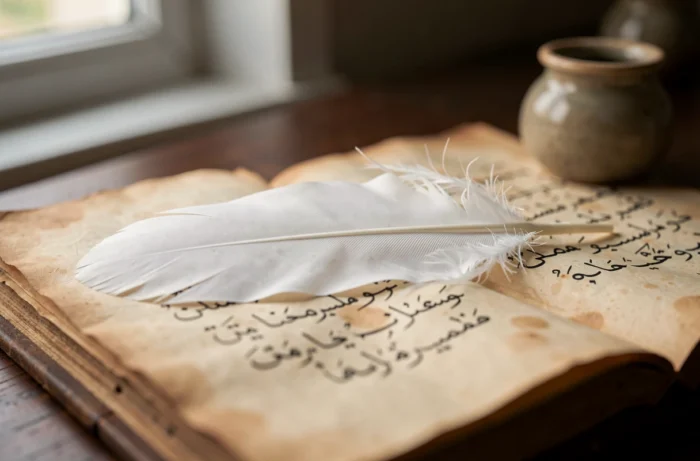
The Surah Al-Qalam opens with a divine oath: “Nûn. By the pen and what they write.” This verse (68:1) immediately elevates the pen to the rank of objects by which God swears, a status reserved in the Quran for realities of considerable significance. The pen, in the Quranic text, is neither an ornament nor a mere writing tool.
It refers to the foundational act by which destiny was recorded, long before the creation of the heavens and the earth.
The pen in Islamic doctrine: an instrument of divine decree
Classical exegeses distinguish several levels of interpretation of the word “pen” in Surah Al-Qalam. Here, the pen refers to the instrument by which Allah commanded the inscription of all things. A hadith reported by At-Tirmidhi, Abû Dâwûd, and Ahmad specifies that the Pen was commanded to write destiny and everything that would happen.
This original Pen is nothing material in the usual sense. Islamic sources indicate that after the creation of water and the Throne, Allah created the Pen, then commanded it to write on the Preserved Tablet (Al-Lawh Al-Mahfûz). The dimensions and appearance of this Pen remain unknown: no text provides a physical description.
The theological stakes are clear. The pen symbolizes predestination and divine sovereignty over creation. Understanding the meaning of the pen in Islam requires first linking it to this doctrinal function rather than to a divinatory reading.

Quranic pen and found pen: the boundary between theology and popular belief
Research findings on the pen in Islam mix two distinct registers. The first pertains to the Quranic text and prophetic tradition. The second belongs to popular or esoteric interpretations that attribute a personal, even angelic, message to a physical pen found at home.
The Quran does not present the pen as an angelic message associated with a particular color. The correspondence tables (white pen = peace, black pen = wisdom, red pen = passion) circulating online have no basis in canonical Islamic texts. These grids originate from various spiritual traditions, often syncretic, that borrow from New Age currents or beliefs predating Islam.
What the exegetes say about material signs
The dominant theological position in Sunni Islam clearly distinguishes faith in divine destiny from the interpretation of everyday objects as omens. The concept of tiyara (superstition related to omens) is explicitly discouraged by several hadiths. Attributing a personal spiritual message to a found object is, from this perspective, a practice that classical doctrine does not validate.
The consulted sources indicate exegetical discussions about the exact order of creations (water, Throne, Pen), with variations in transmission among the chains of narrators. This relative ambiguity regarding cosmogonic chronology contrasts with the doctrinal certainty about the function of the Pen: to record the divine decree, without ambiguity.
The functions of the qalam: writing, knowledge, and transmission
Commentaries on Surah Al-Qalam distinguish several pens in Islamic tradition:
- The pen of divine decree, which inscribed the destiny of all things on the Preserved Tablet before the creation of the world
- The pens related to angels, tasked with recording the actions of human beings throughout their lives
- The human pen, an instrument of knowledge, writing, and the transmission of knowledge between generations
This classification strongly nuances the idea that a material pen found on the ground would carry a personal message. The qalam is primarily a symbol of knowledge and the obligation to learn, a recurring theme in the Quran (the first revelation, Surah Al-Alaq, commands “Read!”).
Arabic calligraphy itself is part of this continuity. The reed pen used by calligraphers is not merely a craft tool. It extends, in artistic and spiritual practice, the link between writing and the sacred that the Quran establishes from its earliest revelations.
Pen in Islam and dream interpretation: a distinct field
Oneiromancy (dream interpretation) holds a recognized place in Islamic tradition, unlike the interpretation of found objects. Seeing a pen in a dream may be subject to symbolic reading in classical interpretation works, depending on the context of the dream, the color, and the associated action.
In contrast, automatic interpretation grids (“white pen = guardian angel”) do not align with the methodology of recognized interpreters in Islamic tradition. The interpretation of a dream in Islam depends on the overall context, the spiritual state of the dreamer, and the competence of the interpreter. Reducing this discipline to a simplified color code distorts its method.
What the sources do not clarify
The available data do not allow for a conclusion about the precise historical origin of the color-meaning correspondences applied to pens in an Islamic context. These associations appear in online publications without a clear transmission chain to a classical text. Their growing popularity on social media does not confer theological legitimacy.
- No Quranic verse associates a pen color with a specific message
- No authenticated hadith prescribes reading a sign in a pen found at home
- Reference works in exegesis (tafsîr) treat the pen as an instrument of decree, not as a divinatory object
The pen in Islam carries a dense symbolic charge, but it points to a structuring theological concept: the writing of destiny precedes creation itself. This symbol speaks of divine sovereignty, knowledge, and transmission. Reducing it to a domestic omen misses what the Quranic text places at the heart of its opening oath.