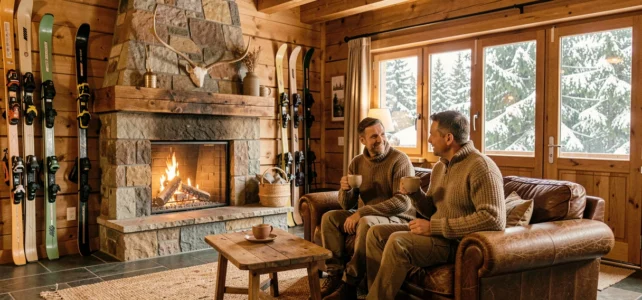
Mountain tourism in Savoie is undergoing a rapid transformation. Between a tightening regulatory framework for tourist accommodations and a growing demand for immersive stays, the Savoyard hotel-chalet occupies a unique position. This type of accommodation, halfway between traditional hotels and private chalets, offers an experience built around mountain architecture, local gastronomy, and a territorial anchoring that short-term rental platforms struggle to replicate.
Regulation of Tourist Accommodations in Savoie: What Changes for Mountain Stays
The law n° 2024-1039, which came into effect on January 1, 2025, has reshuffled the cards of tourist accommodation in mountain areas. Municipalities now have enhanced tools to regulate tourist accommodations, with civil fines that can reach 100,000 euros per irregularly converted unit.
Starting May 20, 2026, the declaration and registration of any short-term rental will become mandatory in all French municipalities via a national tele-service. This measure directly affects chalets rented as seasonal accommodations.
The case of Annecy illustrates this trend. The city capped the number of tourist accommodation permits in 2025 at 2,660, down from about 6,400 previously, representing a 58% reduction. The permit is personal, limited to one per owner, and valid for four years without automatic renewal. This type of restrictive zoning could extend to other tourist municipalities in Savoie.
For travelers, the direct consequence is a contraction in the supply of individual chalets for short-term rental. The hotel-chalet, which falls under the classic hotel regime and not under tourist accommodations, is not subject to these restrictions. Its business model is strengthened by this regulatory context, although the concrete effect on booking rates remains to be measured over several seasons.
Among the establishments that embody this hotel-chalet format in Savoie, there are addresses like lafermettedemarie.fr, whose positioning is based on traditional architecture and a deliberately limited size.
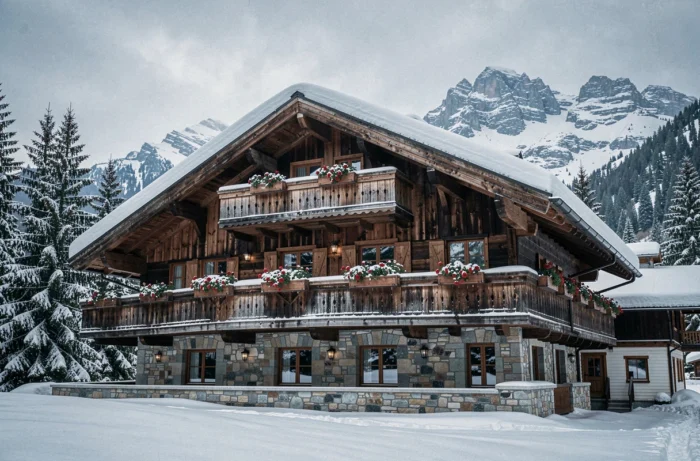
Savoyard Hotel-Chalet: What Distinguishes the Format from Other Mountain Accommodations
The term “hotel-chalet” encompasses various realities, but several structural criteria recur in Savoyard establishments that claim this designation.
- A building that incorporates the codes of mountain chalets (solid wood, local stone, steep roofs) while integrating current hotel standards (accessibility, fire safety, thermal insulation)
- A reduced accommodation capacity, often fewer than 30 rooms, allowing for a higher staff-to-guest ratio than in chain hotels
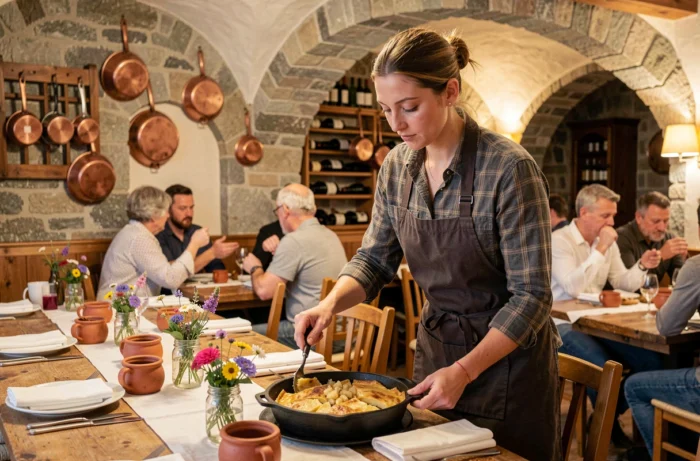
- A dining offer rooted in Savoyard terroir (farm reblochon, diots, polenta, Savoie wines), sometimes with an identified chef and documented short supply chains
- Common areas designed as living spaces (lounge with fireplace, bar, library) rather than mere transit zones
The difference with a rental chalet mainly lies in the service dimension. A hotel-chalet takes care of daily housekeeping, dining, and often a wellness area (sauna, Nordic bath). The traveler does not have to manage the logistics of the stay.
On the other hand, flexibility is lower. One does not cook in their room, breakfast hours are fixed, and the space per person remains smaller than that of a private chalet. The choice depends on the balance between desired autonomy and delegated comfort.
Environmental Commitment of Hotel-Chalets: Labels and Limits
Several Savoyard hotel-chalets display environmental commitments. Reduction of single-use plastics, choice of eco-labeled cleaning products, sourcing from local producers, waste management with enhanced selective sorting. Some go further with rainwater harvesting systems or wood boilers.
The available data does not allow for conclusions about the real impact of these initiatives on the sector level. No single label certifies the entire hotel-chalet sector in the mountains. The European Ecolabel, the Green Key, or the Green Globe label each cover different criteria, and most small establishments have not engaged in formal certification.
The old buildings, common in renovated hotel-chalets, pose a specific challenge. Stone walls and traditional frameworks offer interesting thermal inertia in summer, but their winter insulation often remains insufficient compared to current standards. Renovating an old chalet without altering its architectural character costs significantly more than a new construction compliant with RT 2020 standards.
Mountain in Summer: Why the Savoyard Hotel-Chalet is Gaining Ground Outside the Ski Season
Summer attendance in the French mountains is steadily increasing. The mountains are establishing themselves as a full-fledged summer destination, driven by the search for coolness and outdoor activities.
For a hotel-chalet, the summer season represents a profitability lever. Fixed costs (staff, maintenance, energy) run all year. Extending the operating season beyond winter allows for amortizing these costs over a longer period.
The typical summer offer of a Savoyard hotel-chalet is organized around hiking, mountain biking, visits to alpine farms, and discovering built heritage. Some establishments offer thematic stays (plant picking, introduction to Savoyard cuisine, mountain photography workshops).
The main limitation remains accessibility. Many hotel-chalets are located in villages away from major roads. The lack of frequent public transport makes a car almost essential to access these establishments outside the ski season when shuttle services are no longer running.
The tightening regulations on tourist accommodations opens up space for the hotel-chalet format, while travelers’ expectations for sustainability and authenticity align with its positioning. The establishments that will benefit the most from this context are those that have financed the thermal renovation of their buildings while extending their opening calendar beyond just the ski season.