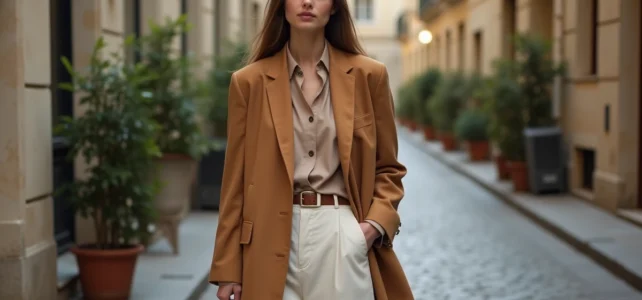
The French regulatory framework is evolving to regulate ultra-fast fashion, with penalties that could reach €20 per item by 2030 for the brands concerned and a total ban on advertising for these products starting January 1, 2027. This context is pushing the market towards durable, traceable pieces designed to last several seasons.
These legislative changes are directly altering the fashion trends visible on runways and in commercial collections.
Textile Traceability and Garment Identity Card: The New Style Criterion
Major ultra-fast fashion platforms will now have to display the main stages of a garment’s production (weaving, dyeing, manufacturing) and messages encouraging sobriety, reuse, and repair. This requirement creates a new selection filter for discerning consumers.
In concrete terms, a dress or pair of pants whose identity card reveals a short supply chain and certified materials gains perceived value. We recommend considering this transparency as a true style marker, on par with a cut or print.
Brands that anticipate this requirement are already offering capsule collections where each piece carries a QR code linking to its production journey. This is no longer a peripheral marketing argument; it is a stylistic differentiation element.
Designers who work with plant-based dyes or recycled fibers integrate this directly into the design, with visible labels, exposed seams, or intentionally raw finishes that tell the garment’s origin story.
To delve deeper into these topics and spot pieces that combine transparency and aesthetics, Mister Free Free’s fashion section closely follows these regulatory developments and their impact on wardrobes.

Oversized Cuts and Architectural Volumes: Spring-Summer Fashion Trends
Volume remains the dominant territory of expression this season. Oversized cuts are no longer limited to a loose sweater worn over jeans: they extend to structured short jackets, barrel pants, and babydoll dresses with dropped armholes.
The barrel cut on jeans is gradually replacing the slim in women’s and unisex wardrobes. Its flared silhouette at the thighs and then tapered at the ankle creates a play of proportions that works well with both flat sandals and heeled mules.
On the jacket front, the trend focuses on two axes:
- The colorful short jacket, worn open over a minimalist top, which structures the upper body without weighing down the summer silhouette
- The short trench, reimagined in lightweight materials (linen, coated cotton), which replaces the classic blazer for mid-season days
- Ultra-light technical parkas, repurposed from outdoor wardrobes to urban looks with fitted shoulder cuts
We observe that these volumes work best when concentrated on a single area of the body. A wide barrel pant calls for a fitted top. An oversized jacket requires a structured bottom. The contrast of volumes between top and bottom remains the most reliable proportion rule.
Bold Colors and Prints for a Distinctive Look
Butter yellow emerges as the standout color of this spring-summer season. This soft hue, halfway between pastel and saturated, is seen on midi dresses, poplin shirts, and leather accessories.
What sets this palette apart from previous seasons is the absence of warm neutrality. Bold colors are worn in blocks, not as discreet accents. A beige pant no longer serves as a neutral base: it becomes the central piece of the look, paired with a top in a neighboring tone for a bold monochrome effect.
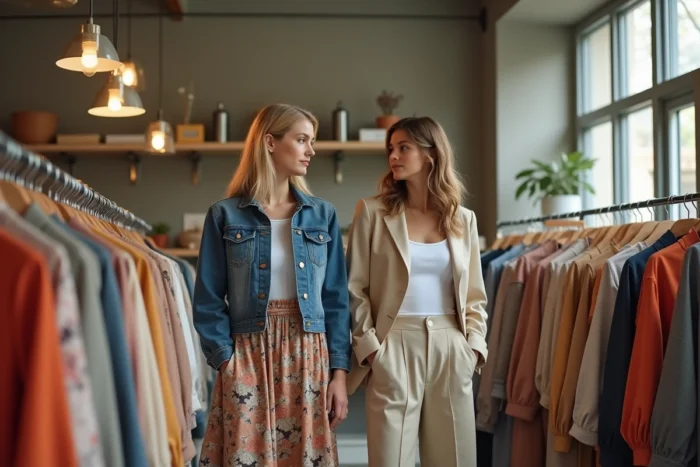
On the print side, oversized floral patterns and irregular stripes dominate. The geometric prints of past seasons give way to more organic designs, often inspired by textile craftsmanship. Tie-dye dyes evolve towards controlled gradients, closer to Japanese shibori than to summer festival styles.
For accessories, bags made from woven materials and colorful resin jewelry complement this chromatic direction. The coherence of the palette between clothing and accessories becomes a more readable style marker than the accumulation of disparate pieces.
Second Hand and Sustainable Materials: Building a Unique Style Without Fast Fashion
The ban on promoting fast fashion by influencers, accompanied by a fine of up to €100,000 per violation, will mechanically redirect fashion content on social media. Shein or Temu hauls will disappear from French feeds, replaced by content focused on second-hand, repair, and durable pieces.
This shift has direct consequences on building a personal wardrobe. Investing in vintage or second-hand pieces allows access to cuts and materials that current production no longer offers: thick gabardines, silk linings, metal buttons.
- Vintage blazers from the 1980s-1990s offer structured shoulders that current brands often attempt to reproduce, usually with less hold
- Second-hand viscose crepe dresses have a drape that cheap synthetic fibers cannot imitate
- Second-hand raw jeans, already worn in, skip the break-in phase and provide immediate visual character
France is the first EU country to ban the promotion of ultra-fast fashion, positioning the French market as a laboratory for a new relationship with clothing. Progressive penalties on low-cost items will make fast fashion less price-competitive, accelerating the shift towards thoughtful purchases.
A unique style is not built by following every seasonal micro-trend. It is built on pieces whose origin is known, whose cut withstands cycles, and whose materials age without degrading. French regulation, by making the real cost of disposable fashion visible, gives a concrete advantage to those who choose their clothing with this requirement.