
The meter reading remains the only reliable indicator of a household’s actual consumption. Any estimation based on national averages obscures the variations related to the type of housing, network pressure, and installed equipment. Assessing your daily water consumption at the tap requires cross-referencing counting data with a detailed analysis, then acting on the most cost-effective technical levers.
Remote reading and meter monitoring: measure before reducing your water consumption
We recommend distinguishing between two levels of measurement. The first, accessible to everyone, involves reading your meter at regular intervals (weekly or daily) and relating the volume to the number of occupants. The second utilizes remote reading, which is being deployed but remains uneven across the territory.
According to the Professional Federation of Water Companies (FP2E), about one third of meters were remotely read in September 2026. This technology allows communities to send targeted alerts in case of abnormal consumption, particularly during resource pressures. For equipped users, remote reading transforms the meter into a behavioral assessment tool: it identifies peak hours, suspicious nighttime flows, and gradual drifts.
By comparing your reading to the tap water consumption on Concept Maison, you obtain a concrete reference point to situate your household. The gap between your actual value and the documented average forms the basis of any reduction plan.
A simple test to spot leaks: note the meter index before bed, without using water overnight. If the index has moved by morning, a leak is likely. A dripping faucet alone represents a considerable volume over a year.
Network pressure and tap flow: the underestimated technical parameter
The distribution pressure directly conditions the volume discharged per minute. In most homes, network pressure fluctuates between 2 and 5 bars, which radically changes the flow of the same tap depending on the address. We observe that this factor is almost always absent from consumer guides, which focus on usage duration without questioning the actual flow.
Installing a pressure reducer upstream of the domestic network (set around 3 bars) standardizes flows and reduces consumption without changing habits. This device also protects the faucets and hoses, whose lifespan decreases under excessive pressure.
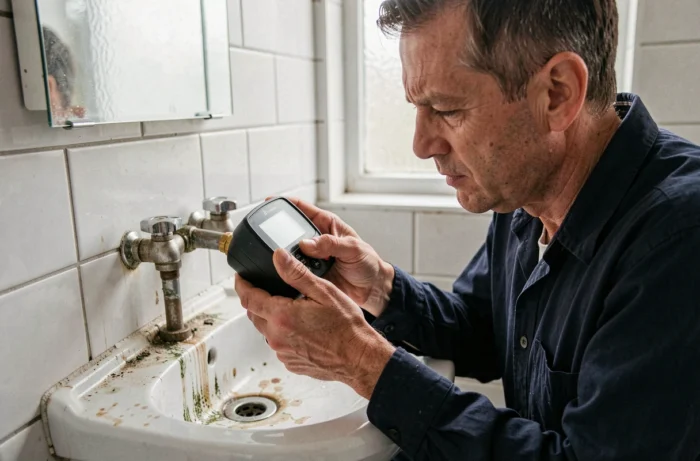
For each draw-off point, a temporary flow meter (a few euros at a garden center) allows you to measure the actual flow in liters per minute. This data, cross-referenced with daily usage duration, provides a much more precise item-by-item assessment than a theoretical estimate.
Aerators and flow limiters: specifications to check
Aerators (flow restrictors) reduce flow by 30 to 50% by injecting air into the stream, without noticeable loss of comfort when washing hands or doing dishes. We recommend checking three parameters before purchase:
- The target flow in liters per minute (a model at 5 L/min is suitable for a sink, while a kitchen sink requires at least 6 L/min to remain functional)
- The faucet threading (M22 or M24 standard, adapter needed for non-threaded spouts)
- The compatibility with local hard water, which quickly clogs certain low-end models
Network losses: why your household savings are not enough
A rarely addressed angle in reduction guides: one liter of drinking water out of five is lost in the public network before reaching the tap, according to 2024 data from the French Office for Biodiversity reported by L’Est Républicain in September 2026. Territorial disparities are significant, with losses below 10% in some areas and reaching about a third in others.
This finding does not exempt one from acting at home, but it puts into perspective the impact of household gestures alone. A household that reduces its consumption by 20% in a municipality where the network loses a third of the produced water contributes to a modest overall gain. We believe that evaluating one’s own consumption benefits from integrating this territorial data, which can be consulted via your municipality’s annual water service report.

Toilets and hot water production: the two areas to prioritize
The toilet flush and the production of hot sanitary water account for the majority of the volume consumed in a home. Acting on these two areas produces more significant results than multiplying small gestures at the sink or basin.
Dual flush toilet
Replacing a simple mechanism with a dual volume mechanism substantially divides the volume per flush on the small button. Ensure that the float is correctly adjusted: a float that is too high causes a continuous flow into the bowl, often inaudible but measurable at the meter.
Hot sanitary water and invisible waste
The wait time before hot water arrives generates a lost volume with each draw. In homes where the tank is far from the draw-off points, several liters of cold water are flushed before each shower. Two technical solutions exist:
- Hot water recirculation (permanent or programmed circulation), suitable for large areas but energy-consuming if poorly sized
- Collecting the cold purge water in a bucket for domestic use (watering, cleaning), a solution with no investment
- Bringing the production point closer to the main draw-off point during a renovation, which eliminates the problem at the source
On the shower side, switching from a standard showerhead to a low-flow showerhead remains the gesture with the best investment/savings ratio. Turbine or shower-stop models allow you to cut the flow during soaping without losing the temperature setting.
The documented decrease in household consumption between 2022 and 2024 in France shows that these technical adjustments are gradually spreading. However, individual evaluation, meter in hand, remains the only way to verify that the installed equipment produces the expected effect on your actual bill.