
Finding a home that suits your lifestyle means looking beyond first impressions. Since January 1, 2025, selling a detached house rated E on the DPE requires a mandatory energy audit in addition to the energy performance certificate, including costed renovation scenarios. This document changes the equation: it helps you estimate the true cost of a project before you even sign a preliminary sales agreement.
Climate risks at the property address: what the risk report may not always show
The risk report provided during a transaction lists known hazards (flooding, seismic activity, radon). Since January 1, 2025, brush-clearing requirements must also be included in property listings and in this document for properties concerned.
Clay shrink-swell remains a frequently overlooked risk. The exposure map is available free of charge, but the property’s own claims history provides more concrete information. A plot in a medium-risk area may never have shifted, while one in a low-risk area may have been subject to repeated natural disaster claims.
Whether a property can be insured depends directly on this information. A home exposed to recurring damage may face rising premiums or reduced coverage at renewal. Checking the address on the clay exposure map, cross-referencing it with natural disaster orders issued for the municipality, and asking the seller for the claims history are three steps to take before making an offer.
For an overview of the types of homes available in Belgium and their features, see this useful resource: https://habitations.be.
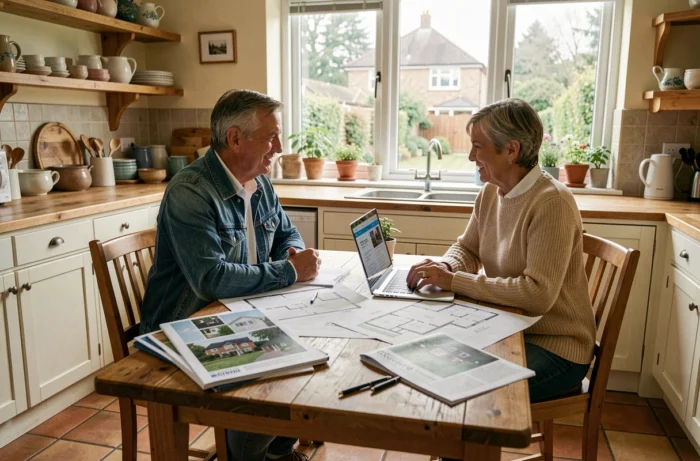
Summer comfort and the DPE: two different ways of assessing the same home
A good DPE mainly assesses winter energy consumption. It says very little about how a home performs in hot weather. Two homes rated B can offer radically different experiences in August.
Shade, solar protection and night-time ventilation have a much greater impact on summer comfort than the energy rating. A south-facing home with large windows and no exterior shutters or sunshades will be difficult to cool, even if it is perfectly insulated.
What to check during a summer viewing
- Whether the south- and west-facing walls have exterior solar protection (shutters, blinds, architectural overhangs) to block heat before it passes through the glass
- Whether cross-ventilation is possible at night, which requires openings on at least two opposite sides of the home and sufficiently cool outdoor temperatures overnight
- The vegetation around the building: a deciduous tree on the south side provides shade in summer and lets sunlight through in winter—something no mechanical system can replicate as simply
Viewing a property only in winter can hide these factors. If the viewing takes place in the colder months, checking the plans, orientation and solar protection features can help to some extent.
Energy audits and the true cost of an E- or F-rated property
Since 2025, the mandatory energy audit for detached houses rated E must present at least two renovation scenarios and their impact on the DPE rating. This document turns an abstract figure (the letter) into a concrete budget.
A property listed at an attractive price may end up being the most expensive in the neighbourhood once renovation costs are factored in. The purchase price and renovation costs should be assessed together as a single budget.
How to read an energy audit before negotiating
The audit’s “staged” scenario sets out priority work in a logical order. Insulating the attic before replacing the heating system, for example, avoids oversizing the equipment. The “comprehensive” scenario proposes a full renovation in a single phase, which is often more effective but more expensive.
Comparing the two scenarios can help you set your offer. An E-rated property whose audit shows it could reach C with moderate work (attic insulation and window replacement) is a better deal than a D-rated property requiring a complete overhaul of its building envelope.

Local market and construction type: compare like with like
Prices and sales volumes do not necessarily move in the same direction across different areas. A nationwide price drop may conceal local increases in well-connected municipalities, and vice versa.
Comparing properties by type and local market gives a more reliable picture than national real estate trends. A stone house in a rural village and an 1980s suburban home face different thermal challenges and price dynamics.
- Older stone or earth-built homes often offer good thermal mass (keeping cool in summer), but may have costly thermal bridges to address
- Homes built in the 1970s to 1990s are generally the most energy-intensive, with minimal insulation and original single-glazed windows
- Homes built after 2012 comply with RT 2012 and have a reasonable baseline level of insulation, but summer comfort is not always guaranteed
Combining the construction type with the energy audit and risks at the property address gives a more complete picture than simply looking at the price per square metre. The home that remains comfortable and financially viable ten years from now is not always the one that wins you over at first glance. The DPE rating, exposure to climate hazards and a realistic renovation budget are three filters to apply systematically, whatever type of property you are considering.