
The Budwig cream is based on a precise blend of raw ingredients (quark, flaxseed oil, oilseeds, whole grains, fresh fruits). Popularized by the Kousmine method in the 1950s, this preparation still divides the nutritional community. What do the available data really say about its composition, benefits, and limitations?
Flaxseeds and flaxseed oil: a very different level of risk
The most common confusion in articles about Budwig cream concerns flax. Many mainstream articles treat “flaxseeds” and “flaxseed oil” as a single block, while the cyanogenic risk mainly concerns the seeds, not the oil. Cyanogenic compounds (linamarin, lotaustraline) mostly remain in the solid residue during pressing.
The classic Budwig recipe contains a modest fraction of flaxseeds. For young children, caution is more pronounced, as the tolerable dose is proportionally lower.
Flaxseed oil poses another problem: the rapid oxidation of omega-3 fatty acids. Poorly stored flaxseed oil (exposed to heat, light, or opened for several weeks) develops potentially harmful oxidation compounds. This fragility requires refrigeration and quick consumption after opening. Exploring the dangers of Budwig cream helps to better understand these often underestimated preparation constraints.
| Component | Main Risk | Condition of Occurrence |
|---|---|---|
| Flaxseeds (whole or ground) | Cyanogenic compounds | Overconsumption, ingestion by young children |
| Flaxseed oil | Oxidation of omega-3s | Poor storage (heat, light, bottle opened too long) |
| Quark | Lactose intolerance | Undiagnosed intolerant individuals |
| Oilseeds (nuts, sunflower) | Major allergens | Nut allergy |
Proteins and fatty acids: what Budwig cream really provides
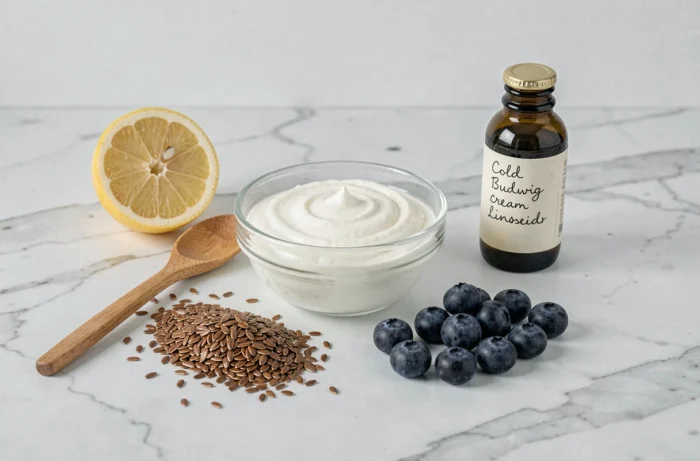
The combination of quark and oilseeds provides a protein intake at breakfast, distinguishing it from a classic breakfast of white bread and jam. Quark provides dairy proteins of good biological value, while the seeds add polyunsaturated fatty acids.
The nutritional interest lies in the complementarity of proteins, fats, and fibers, not in an isolated ingredient. Whole grains (millet, buckwheat, oats) complement the profile by providing fiber and complex carbohydrates. Fresh fruits add vitamins and antioxidants.
Budwig cream is not a miracle food. No clinical study published in a peer-reviewed journal has demonstrated that this specific preparation prevents cancer or cures a chronic disease. The health claims sometimes associated with the Kousmine method have not been validated by the relevant European authorities.
Concrete contributions of a typical bowl
- Combined dairy and plant proteins, promoting satiety until lunchtime
- Plant-based omega-3s (ALA) from flaxseed oil or seeds, with a conversion rate to active long-chain forms (notably DHA) that remains low in adults
- Fibers from whole grains and seeds, contributing to intestinal transit
Health claims and the Kousmine method: where is the debate now?
Dr. Johanna Budwig developed this recipe in a therapeutic context related to her research on fatty acids. Catherine Kousmine, a Swiss doctor based in Lausanne, later integrated it into her overall dietary method. The debate has gradually shifted from nutritional promises to the validity of health claims.
European regulations strictly govern the allowed claims on food products. Claiming that a food “prevents cancer” or “boosts the immune system” without sufficient scientific evidence is prohibited. The Kousmine method as a whole has not undergone large-scale randomized clinical trials.
This does not mean that Budwig cream is without merit. A homemade preparation based on raw, unprocessed ingredients remains nutritionally superior to most industrial breakfasts. The difference between a bowl of Budwig cream and a bowl of ultra-processed cereals can be measured in terms of lipid quality, absence of additives, and nutritional density.

Food contaminants: the recent regulatory point
A rarely addressed angle concerns process contaminants in vegetable oils. Regulation (EU) 2026/1825, published in July 2026 and applied from August 19, 2026, sets new limits for 3-MCPD esters and glycidyl esters in certain food categories, including preparations intended for infants.
This regulation does not directly target Budwig cream, but it concerns any preparation containing a significant lipid fraction. Artisanal cold-pressed oils are not systematically tested for these contaminants, unlike industrial oils subject to batch controls.
For those preparing Budwig cream at home, the choice of oil thus has an importance that goes beyond the simple question of omega-3s. Prioritizing virgin flaxseed oil from a producer transparent about its analyses (peroxide value, absence of contaminants) is a reasonable precaution.
Homemade Budwig cream or industrial product: not the same profile
Some manufacturers market ready-to-use mixes inspired by the Budwig recipe. The comparison with the homemade version reveals significant discrepancies.
- Industrial mixes sometimes contain pre-ground seeds whose oxidation began well before purchase
- The addition of sugars or flavors alters the initial nutritional profile of the recipe
- The freshness of the oil, a central parameter of the original recipe, cannot be guaranteed in a mass-produced product with a long shelf life
The homemade version prepared with fresh ingredients remains the only one true to the original principle. Grinding the seeds just before use, using recently opened and cold-stored flaxseed oil, choosing quark without additives: these actions determine the actual quality of the bowl.
Budwig cream is neither a remedy nor a danger in itself. Its value depends on the quality of the ingredients, adherence to the quantities of flaxseeds, and the rigorous storage of the oil. For a breakfast rich in proteins and quality fatty acids, it remains a solid option, provided that no therapeutic virtues are attributed to it that no scientific data confirms.