
The national average price displayed by comparators for 1,000 liters of ordinary heating oil is around 1,740 to 1,770 euros in September 2026, delivery included. This figure aggregates very different realities depending on the distance to the depot, the type of product ordered, and the profile of the purchasing household. Understanding how this price is formed allows for more precise timing and volume of orders than simply following a trend.
Breakdown of the heating oil price for 1,000 liters: actual costs and hidden margins
The displayed price for 1,000 liters of domestic heating oil does not correspond to a single price. It results from the stacking of several components, the relative weight of which varies each week.
The price of crude oil (Brent) forms the base. It translates into the wholesale price of diesel and heating oil on the Rotterdam market, which is the reference for Europe. To this spot price are added the refining margin and port logistics costs.
Next comes taxation. The TICPE (domestic consumption tax on energy products) represents a fixed amount per liter, to which a reduced VAT is added. These taxes do not fluctuate with the Brent price, which explains why a drop in oil prices is never fully reflected in the bill.
Last component: the margin of the local distributor and the delivery cost. This is the most variable item from one municipality to another. A depot close to the refinery delivers at a lower cost than a distributor located in a mountainous area, such as the Alps or the Massif Central. The difference between two departments can reach several dozen euros for the same quantity.
To track the price of domestic heating oil today, we recommend comparing not the national averages but the actual quotes for your postal code, including the chosen delivery window.
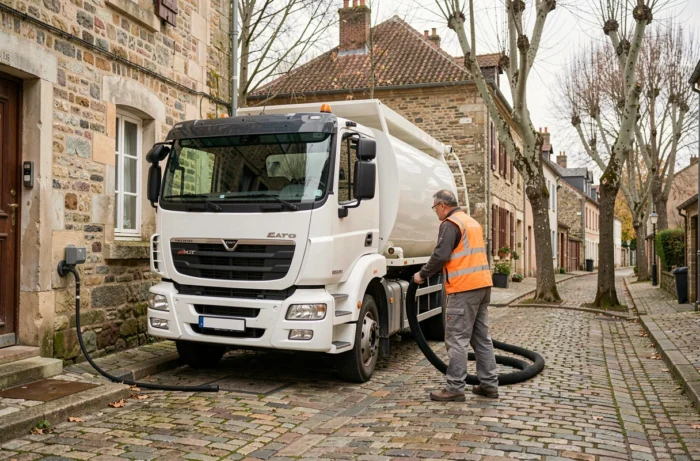
Domestic heating oil in rural areas: a price that does not reflect the same budget
Comparators display a national average, but this average masks a structural bias. In 2022, 2.6 million primary residences were still heated with oil, representing 8.5% of the stock. The over-representation is clear in sparsely populated rural areas, where nearly 16.7% of homes use this energy, compared to only 3.5% in large cities.
Heating oil primarily affects rural households, often with modest means. The price for 1,000 liters weighs more heavily in the budget, especially since these households also face delivery surcharges due to the distance from depots. A difference of a few cents per liter, multiplied by 2,000 or 3,000 liters annually, changes the equation.
This reality explains why group ordering remains a relevant lever in rural areas. Pooling several neighbors for the same delivery reduces the unit logistics cost. Some groups obtain prices significantly lower than the average regional price displayed online.
Evolution of heating oil prices and oil prices: delays to be aware of
The Brent price has experienced phases of increases and tensions in recent months, followed by corrections. We observe that the price of heating oil at the pump reacts with a delay of several days compared to changes in crude oil prices. This lag is explained by the supply cycle of regional depots, which buy in batches and smooth their prices over the week.
In practice, a drop in oil prices on a Monday does not necessarily appear in the quote on Wednesday. Distributors adjust their price lists based on their actual stock and local demand, not the real-time spot price.
When to order to pay less
Seasonality remains the most predictive factor. Heating demand drops between April and July, which pulls prices down. Ordering outside the heating season, ideally in spring, allows for capturing a more favorable price than in October, when demand picks up again.
- Monitor the Brent price over two to three weeks to spot a downward trend before placing an order
- Compare at least three local distributors, as margin differences on 1,000 liters regularly exceed several dozen euros
- Prefer higher volumes (1,000 liters minimum) to benefit from a decreasing unit price, as most price lists are calibrated on this threshold

Ban on oil boilers and impact on prices in the medium term
Since July 2022, the installation of new boilers exclusively using oil is prohibited in new homes and during replacements. Existing boilers can continue to operate and be maintained, but the stock is mechanically contracting each year.
This contraction has a direct consequence on price. Fewer customers mean less volume for distributors, who must amortize their fixed costs (trucks, depots, personnel) over a reduced number of deliveries. In the long term, the scarcity of demand could keep prices at a high level, even if oil prices drop.
Subsidies for replacing oil boilers
MaPrimeRénov’ finances part of the replacement with a heat pump, a hybrid system, or a pellet boiler. The amounts vary according to household income and the nature of the work. Since September 2026, certain single-action aids have evolved, changing the profitability calculation for households still equipped.
- The energy performance diagnosis (DPE) of a home heated with oil consistently displays an unfavorable energy label, which affects the property’s value at resale
- The cost of replacing an oil boiler with an air-water heat pump becomes profitable more quickly as the price of oil remains high
- Households in rural areas can combine several aid schemes, provided they go through a certified RGE craftsman
The price of heating oil for 1,000 liters remains a useful indicator for managing consumption in the short term. In the medium term, the regulatory trajectory and the decline in the number of equipped households are steering the market towards structural price increases. Anticipating the replacement of an oil boiler becomes financially more relevant each year.