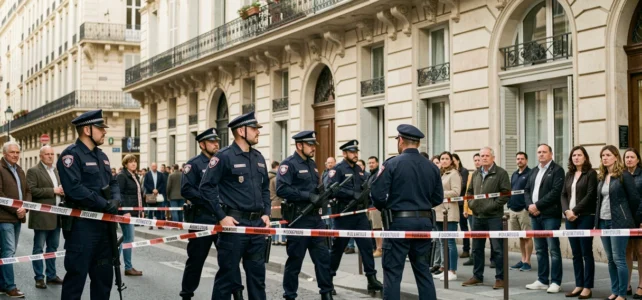
A bomb threat triggers a specific protocol: evacuation of the perimeter, intervention by bomb disposal services, verification zone by zone, and then a gradual lifting of restrictions. In Cannes, where tourist density and the presence of international events concentrate the stakes, this type of incident tests the entire municipal and prefectural security chain within minutes.
Security perimeter and bomb disposal: anatomy of a Cannes protocol
When a threat is reported at a site like the Palais des Festivals, the first operational decision concerns the security perimeter. Law enforcement establishes an exclusion zone, the radius of which depends on the nature of the declared threat and the urban configuration. On the Croisette, this configuration complicates matters: the narrow coastal strip between the sea and buildings limits evacuation routes.
Bomb disposal teams then intervene to inspect the reported area. Their work relies on a methodical progression, piece by piece or sector by sector, using appropriate detection means. As long as this inspection is not completed, the perimeter remains locked down.
The full account of a bomb threat in Cannes shows that the longest phase is not the evacuation itself, but the waiting for the lifting of the perimeter. Evacuated individuals are directed to secure waiting areas, often improvised in adjacent streets or on the beach, while teams complete their checks.

Economic continuity of the festival and security: the ongoing arbitration of Cannes
The question raised by each alert during a major event is that of resumption. Canceling a day of screenings at the Cannes Film Festival represents a considerable logistical and financial cost for distributors, production teams, and local operators. The Cannes protocol therefore explicitly aims to evacuate without canceling.
This logic is based on a principle of compartmentalization. The Palais des Festivals is divided into independent zones. If the alert concerns a specific room or hall, other spaces can theoretically resume their activities once the affected area is secured. Gradual resumption helps limit hourly losses.
The arbitration between security and continuity is not done improvisationally. It relies on pre-established procedures between the Alpes-Maritimes prefecture, the festival management, and municipal services. Each threat scenario corresponds to a graduated response level:
- Unconfirmed alert with identified source: enhanced filtering at access points, systematic searches, maintaining activity under increased surveillance.
- Credible alert requiring partial evacuation: closure of the affected area, redirection of the public to cleared spaces, intervention by bomb disposal teams.
- Threat deemed serious by the prefecture: total evacuation of the site, lockdown of an expanded perimeter, suspension of all activities until the official lifting.
This system allows Cannes to maintain its credibility as an international organizer while respecting security requirements. The city has learned from past alerts to shorten the time between evacuation and resumption.
Cannes Alerte: the municipal crisis management channel
An often overlooked aspect in media accounts centered on the Palais des Festivals is the existence of a dedicated municipal system called Cannes Alerte. This platform, accessible from the official city website, serves as the channel for disseminating instructions to residents and visitors.
Cannes Alerte is not limited to terrorist situations. The service covers all urban risks: floods, fires, maritime pollution, weather events. Its relevance in the case of a bomb threat is to provide verified official information at a time when social media spreads contradictory versions within minutes.
The system operates on a voluntary registration basis. Registered residents receive notifications via SMS or email as soon as an event triggers a prefectural or municipal alert. For tourists, information primarily passes through hotels and festival welcome teams, creating a delay in receiving instructions.

False bomb alerts: criminal qualification and national trend
A significant proportion of bomb threats in France turn out to be false alerts. In Cannes, an individual inebriated was placed in police custody after triggering a false alert. This type of behavior falls under a specific criminal offense.
The penal code punishes the act of communicating false information with the intent to create a belief in a dangerous destruction. The penalties are severe, and police custody is almost systematic to allow investigators to verify the absence of accomplices or real threats.
Cannes is not an isolated case. The year 2026 saw several large-scale bomb disposal operations across France, as illustrated by the evacuation of hundreds of people in the Hautes-Alpes following an alert at a campsite, or the extraordinary bomb disposal in Choisy-le-Roi which required the evacuation of thousands of residents and the interruption of the RER C. These episodes outline a national trend of increased vigilance at highly exposed sites.
The recurrence of these situations raises a concrete operational question: each false alert mobilizes considerable resources (bomb disposal teams, law enforcement, emergency services) and gradually desensitizes the public. Cannes authorities treat each report with the same level of seriousness, precisely to avoid underestimating a real alert one day.
The Cannes case reminds us that managing a bomb threat is not limited to the visible evacuation shown on television images. Behind each incident, a network of procedures, information channels, and graduated decisions determines the speed of return to normalcy and a city’s ability not to let fear dictate its schedule.